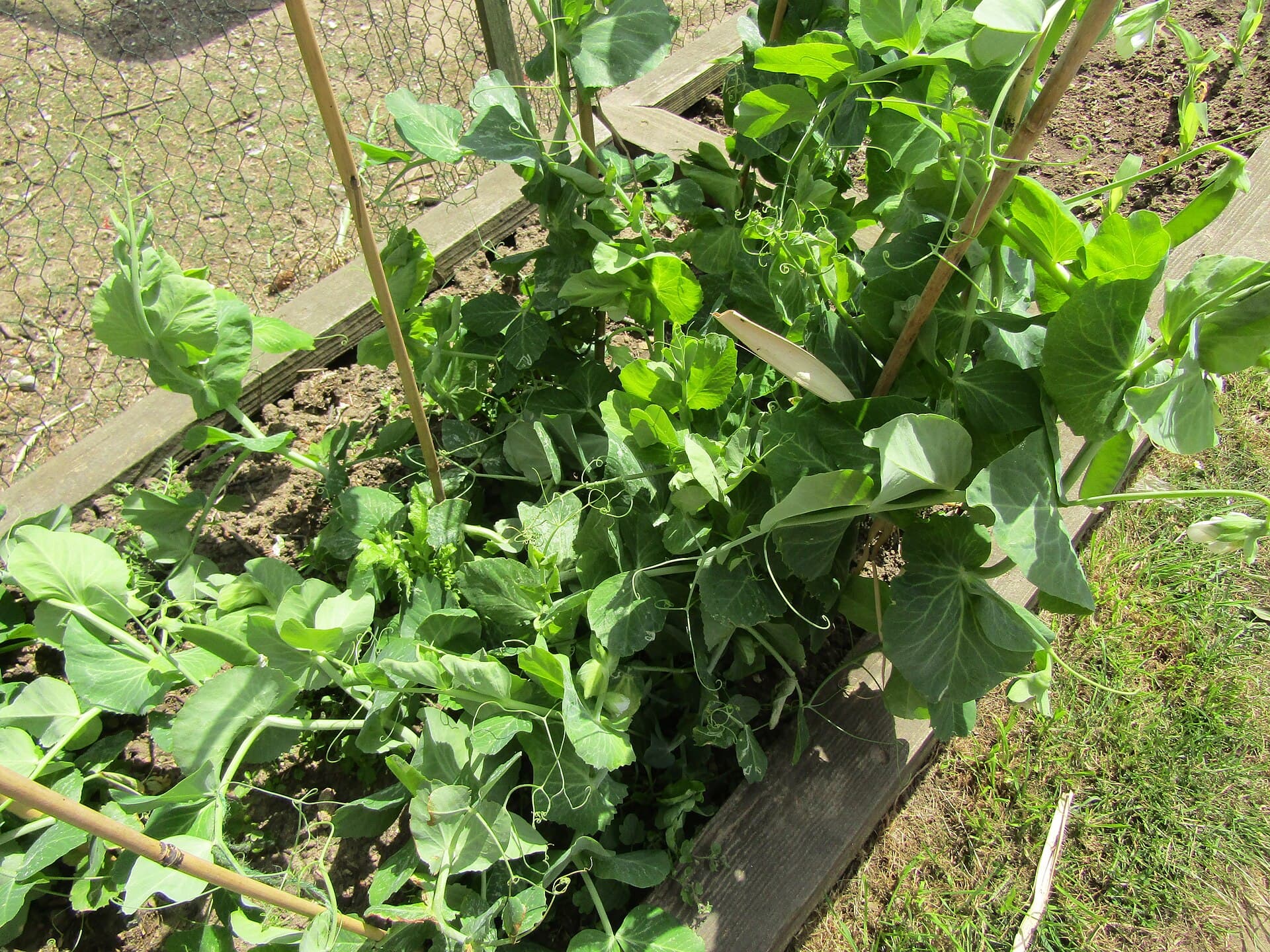
Peas reward an early start. Sow them while the soil is cool and workable, and they can grow through the light frosts that would stop many summer vegetables. Choose what you want to eat before buying seed: garden peas are shelled, snow peas are picked while their pods are flat, and snap peas are eaten pod and all. Those three types share the same basic planting routine but have different harvest cues. University of Minnesota Extension explains the distinctions.
At a glance
- Water: Medium; keep the root zone moist during dry spells.
- Days to maturity: 55 to 70 days, depending on variety and conditions.
- Spacing in the row: 2 to 3 in (5 to 8 cm).
- Spacing between double-row centers: 18 to 24 in (46 to 61 cm), with the two rows in each pair 8 to 10 in (20 to 25 cm) apart.
- Good neighbors, by garden tradition: Carrot, radish, cucumber and corn.
- Keep apart, by garden tradition: Onion and garlic.
When to plant
Sow directly outdoors as soon as the ground has thawed and you can work it without making sticky clods. Maryland Extension recommends waiting until soil is at least 40°F (4°C); below that, germination is slow. Young plants tolerate a light frost, but frost after flowering and pod set can damage the crop. Cover flowering plants when a late frost is forecast, as Minnesota Extension advises.
For a local spring window, ask your state's cooperative extension service for its average last frost date, then watch the soil rather than using a hardiness-zone month. You can make a second sowing a week after the first, and another a week later, to spread the harvest. Allow roughly the seed packet's days to maturity before sustained heat arrives. Peas grow well in cool weather but stop making flowers and pods when temperatures rise above about 85°F (29°C). Minnesota Extension describes the succession sowings and heat limit.
Where and in what soil
Choose a site with good drainage. Peas can grow in different soil textures, but soggy soil invites seedling problems. They grow best at soil pH 6.0 to 7.5; a soil test is more useful than guessing at an amendment. Minnesota Extension gives that range. Full sun produces the strongest crop, though Oregon State Extension says snap peas can live with part shade.
Choose a bush or climbing variety to fit your space. Bush peas are shorter, often about 2 to 3 ft (60 to 90 cm); climbing varieties need a trellis, and some snap pea vines reach 6 to 8 ft (1.8 to 2.4 m), according to Oregon State Extension. Read the seed packet for the particular cultivar before choosing a support.
Planting
Put up a trellis before sowing climbing peas so you need not disturb their roots later. Plant the seeds 1 in (2.5 cm) deep and 2 to 3 in (5 to 8 cm) apart. For paired rows, Maryland Extension places the rows in each pair 8 to 10 in (20 to 25 cm) apart and the pair centers 18 to 24 in (46 to 61 cm) apart; its single wide rows are about 18 in (46 cm) apart. Press the soil gently over the seed. Oregon State Extension also recommends a 1 in seed depth.
Handle seed gently: cracked pea seeds germinate poorly in cool, moist ground. If your seed packet gives a different spacing for a particular bush or climbing cultivar, follow it. Minnesota Extension describes both wide rows and trellised single rows.
Care
Water. In a rainy spring, peas may need little added water. During dry weather, water deeply enough to moisten the root zone, aiming at the soil rather than the vines. Check more often as pods develop; sandy soil dries faster. Minnesota Extension and Maryland Extension both emphasize moisture during dry periods.
Mulch and weed. Organic mulch helps keep the soil moist and weeds down. Pull small weeds by hand or cut them at the surface: pea roots can be shallow, and deep hoeing can damage them. These precautions come from Minnesota Extension.
Feed according to the soil. Start with a soil test rather than a blanket fertilizer dose. Oregon State Extension warns that excess nitrogen can encourage leaves at the expense of pods. Maryland Extension says peas fix little nitrogen and recommends fertilizer before sowing. Because the advice differs, follow your local soil-test recommendation instead of assuming peas need either no nitrogen or a heavy dose.
Good neighbors, and plants to keep apart
Most companion advice for peas comes from gardeners' experience rather than trials that predict a reliable benefit. Gardeners report growing peas near carrots, radishes, cucumbers and corn. They also advise keeping peas apart from onion, garlic, leeks, chives, scallions and shallots. Treat these as optional layout traditions, not a reason to sacrifice sun, drainage, access to the trellis or room for roots. They are no substitute for identifying a pest and choosing an appropriate response.
Pests and problems
Poor emergence. If seeds fail to come up, check for cold, wet soil or damaged seed. Germination slows below 40°F (4°C), and overly wet soil can cause seedling root rot. Wait for workable, draining soil before sowing again. Maryland Extension gives the temperature threshold; Oregon State Extension identifies the root-rot risk.
Aphids and leaf changes. Aphids may cluster on vines, leaving curled or sticky leaves. Powdery mildew can appear during hot, dry weather, and cutworms may sever young plants at the base. Inspect the plant before deciding what caused the damage; the symptoms do not all call for the same response. Minnesota Extension describes these signs.
Flowers without pods. Hot days and nights can cause flowers to abort, and heat can reduce pollination. Keep plants watered during dry weather, but recognize that a spring crop may end as summer heat takes over. Minnesota Extension explains why heat reduces the yield.
Harvest and storage
Check developing pods often; quality can fall quickly after the ideal stage. Garden peas are ready to shell when pods are plump and the peas inside are full sized but still sweet and tender. Snow peas should be full length and flat, with seeds only faintly visible. Snap peas should be juicy and crisp, with peas developing inside but pods still tender. Taste a sample if you are unsure, and remove strings from varieties that have them. These harvest cues come from Minnesota Extension.
Hold the vine with one hand while removing a pod with the other so you do not tear the plant. Cool the harvest promptly and refrigerate it in a ventilated bag or container, as Oregon State Extension recommends.
Common questions
Can I grow peas in partial shade?
Snap peas can tolerate part shade, but full sun gives the highest yield. If your garden offers both, give peas the sunnier spot, as Oregon State Extension recommends.
Do all pea varieties need a trellis?
Tall climbing varieties do. Short bush varieties can sometimes support one another in a wide row, though a modest support can make harvest easier. Check the mature height on the seed packet before planting; Minnesota Extension describes both arrangements.
Can I plant another crop of peas for fall?
Possibly, if your late summer soil cools soon enough and the seed packet's days to maturity fit before your average first fall frost. Ask your state's extension service for local fall timing. Maryland Extension warns that fall peas often perform poorly there: warm soil delays establishment, hot weather hampers growth, and frost can arrive before pods mature.