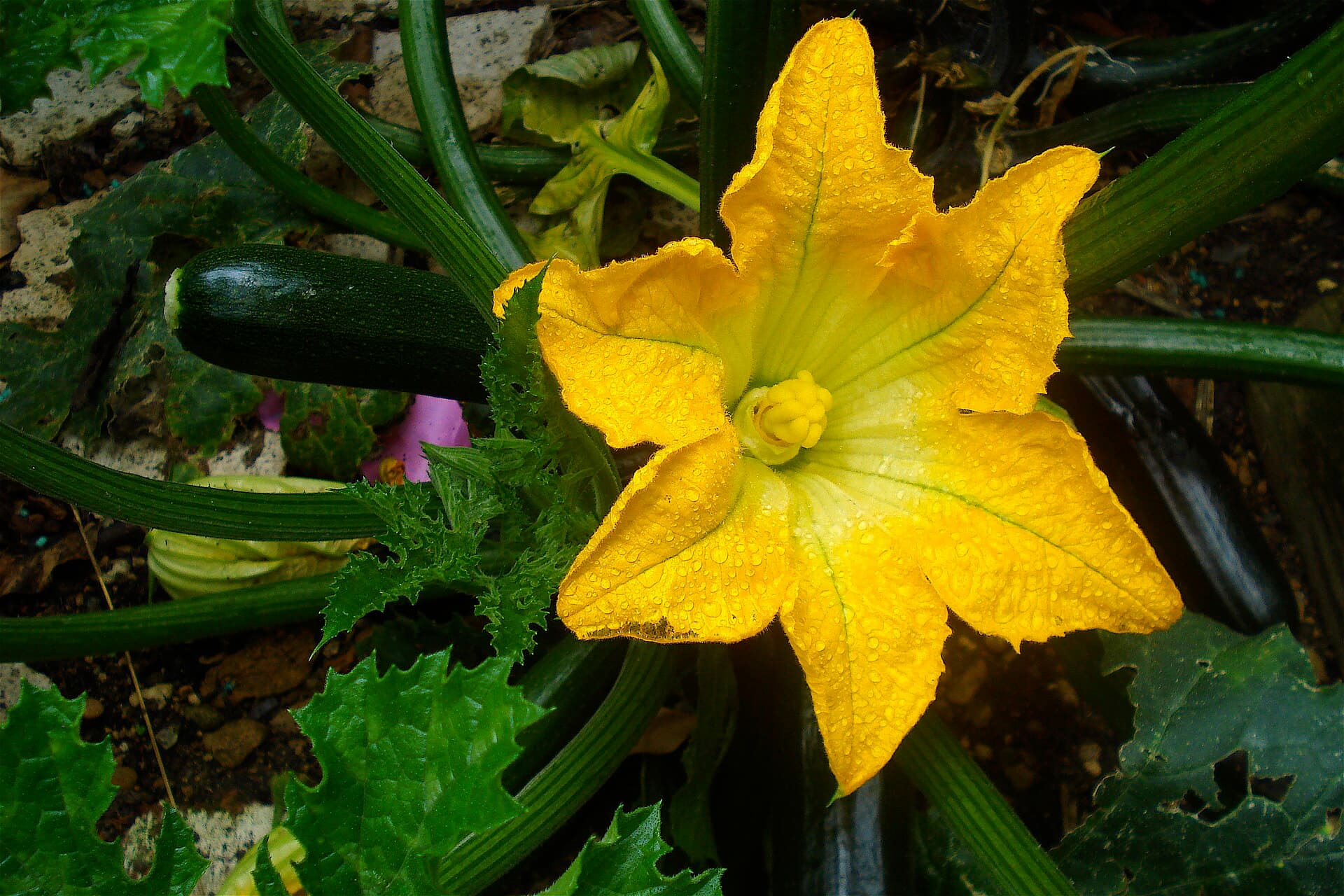
A healthy zucchini plant keeps producing for weeks, but only if you keep picking. Most gardeners go wrong by leaving fruit to grow into oversized, seedy clubs, which slows the plant down. Give the plants room, water deeply and check them every day.
At a glance
- Sun: Full sun
- Water: High
- Days to maturity: 45 to 60 days
- Spacing in the row: 24 to 36 in (61 to 91 cm)
- Spacing between rows: 3 to 4 ft (0.9 to 1.2 m)
- Mature spread: 24 to 36 in (61 to 91 cm)
- Mature height: 24 in (61 cm)
- Good neighbors: corn, beans, nasturtium, buckwheat
- Keep apart from: potato
When to plant
Zucchini and other summer squash are warm-season crops that frost kills. Sow seed outdoors 1 to 2 weeks after your last frost, once the soil is at least 65°F (18°C). Your state's cooperative extension service can give you that date and your average first fall frost date; a hardiness zone cannot, because it reflects the coldest winter temperature and not frost. One extension source prefers direct seeding to indoor-started plants; another allows seed to be started indoors about 3 weeks ahead, one per pot, because squash resents root disturbance. A second sowing in early summer gives you replacement plants if pests or disease take the first, and every planting needs its 45 to 60 days to finish before your first fall frost, which ends the crop. In midsummer heat and humidity the plants decline.
Dates vary widely: in South Florida, UF/IFAS Extension says summer squash can be grown from August to March.
Where and in what soil
Plant in full sun in fertile, well-drained soil with a pH between 6.0 and 7.0. Squash feeds heavily, so dig 2 to 3 inches of compost into the planting area first. The plants spread across a wide patch, so choose a spot where they will not crowd smaller crops.
Planting
Sow seeds 1 inch (2.5 cm) deep, two or three to a spot, and thin to the strongest seedling. Space plants 24 to 36 inches apart in rows 3 to 4 feet apart. Planting on a low mound helps drainage and warms the soil.
Zucchini needs well over a square foot a plant. Extension guides give 2 to 3 feet (0.6 to 0.9 m) between plants in rows 3 to 5 feet (0.9 to 1.5 m) apart, or 2 by 3 feet (0.6 by 0.9 m); one goes as close as 15 to 24 inches (38 to 61 cm) in the row.
Care
Water. Zucchini is thirsty: give it 1 to 2 inches (2.5 to 5 cm) a week, more in heat. Water deeply at the base, not on the leaves, since wet foliage invites mildew.
Mulch. Once the soil is warm, spread 2 to 3 inches (5 to 8 cm) of straw to hold moisture.
Feeding. When the first flowers open, side-dress with compost or a balanced fertilizer, following the label.
Pollination. Each plant carries separate male and female flowers; the female has a tiny fruit at its base. Bees move the pollen. If small fruit yellow and rot from the tip after the flower fades, pollination was poor. In the morning, touch a freshly opened male flower to the center of each female flower.
Good neighbors, and plants to keep apart
Most companion advice for squash is what gardeners report from experience. Plant good neighbors within about 2 feet (60 cm), and keep poor ones at least 4 feet (120 cm) away.
Good neighbors
- Corn and beans: the traditional "Three Sisters" planting, which extension guidance describes.
- Nasturtium, borage and buckwheat: gardeners report that they help.
Keep apart
- Potato: gardeners advise keeping it away from squash.
Pests and problems
Squash vine borer. A healthy plant suddenly wilts. Look near the base of the stem for a small hole and a trail of orange-brown, sawdust-like waste; a white caterpillar is tunneling inside. It is most serious east of the Rocky Mountains. Slit the stem lengthwise with a knife, remove the larva and mound moist soil over the wound. Covering plants with row cover until the first flowers keeps the moths off, though you should skip the cover where squash grew last year. In Minnesota, University of Minnesota Extension describes one generation a year and advises a second planting of summer squash in early July, which matures after the adult borers have finished laying eggs.
Squash bugs. Gray-brown, shield-shaped bugs, with bronze egg clusters on the undersides of leaves; the leaves speckle, wilt and blacken. Check daily in early summer, crush the eggs and hand-pick the bugs. Laying a board by the plants at night traps them for collecting in the morning.
Powdery mildew. A white, powdery coat on the leaves, common late in the season. Water at the base, give plants airflow, remove badly affected leaves and look for resistant varieties. A fungicide labeled for squash is the last step if it starts early; follow the label.
Fruit rotting at the tip. Small fruit that shrivel and rot from the blossom end point to poor pollination or uneven watering. Hand-pollinate and water evenly.
Harvest and storage
Pick zucchini at 6 to 8 inches (15 to 20 cm) long, while the skin is glossy and tender enough to dent with a fingernail. Pick pattypan types when they are 3 to 4 inches (8 to 10 cm) across. Check the plants daily at the peak, and cut the fruit with a sharp knife, leaving a short stem.
Refrigerate unwashed squash in the crisper and use it within about a week. For longer storage, shred and freeze it for baking.
Common questions
Why are my squash flowers falling off without fruit?
Male flowers open first, and they drop after a day. Female flowers, with a small fruit at the base, follow a week or two later.
What is the difference between zucchini and summer squash?
Zucchini is one kind of summer squash. Sources differ on the species: one extension source names only Cucurbita pepo, another names both Cucurbita pepo and Cucurbita maxima. Summer squash is picked young, with tender skin, and eaten soon; winter squash and pumpkins are picked mature, with a hard rind, and stored. This guide covers summer squash only.
Can I grow zucchini in a container?
Yes, with a bush variety in a pot of at least 5 gallons (19 L), with drainage holes. Water daily in hot weather, because a pot dries out far faster than the ground.