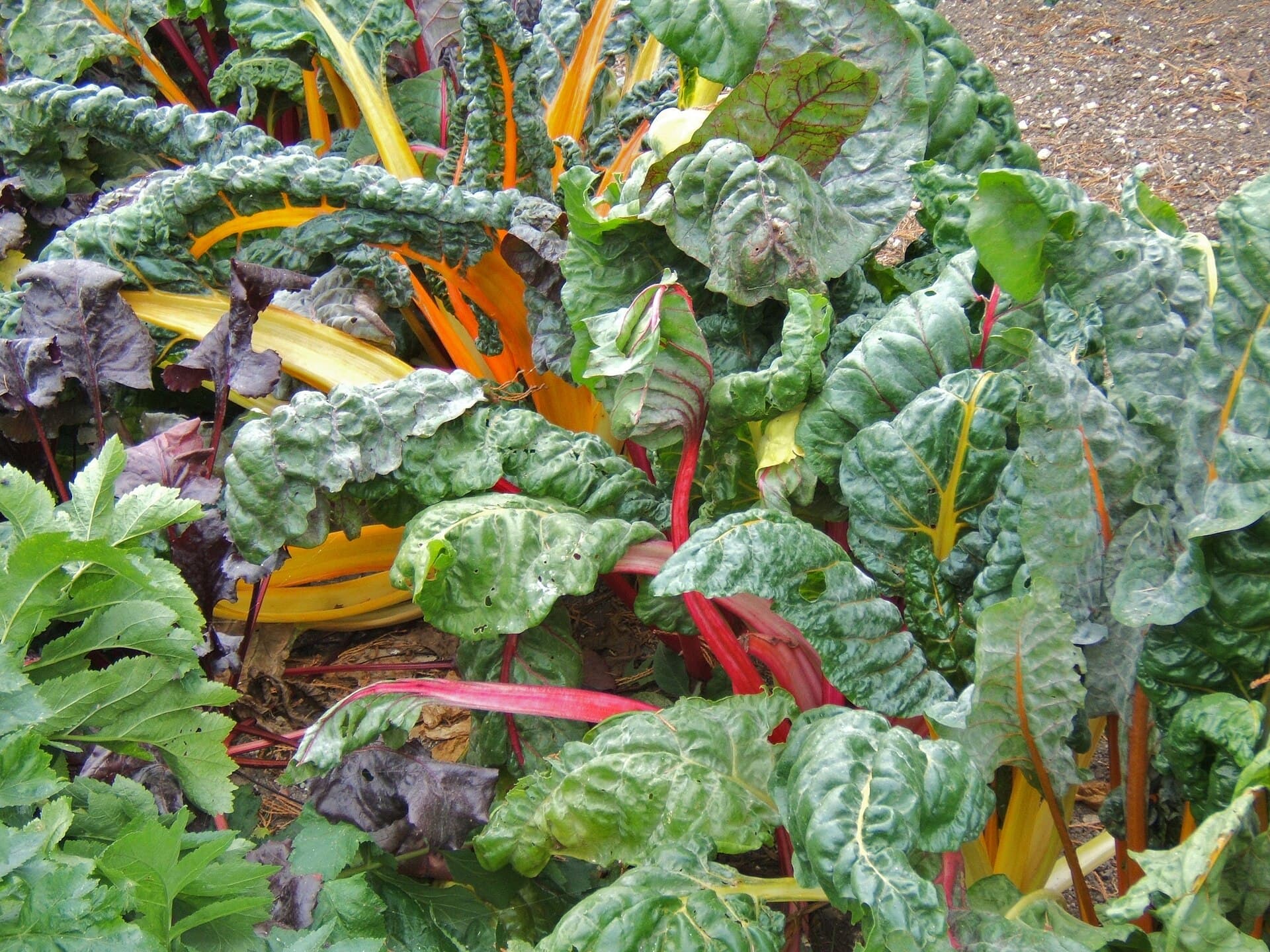
Swiss chard is a beet relative grown for leaves and stalks rather than a swollen root. Green, white-stemmed and colorful cultivars grow in much the same way. Unlike true spinach, chard does not normally flower in response to long summer days, although heat and dry soil can slow leaf growth and lower quality. Minnesota Extension explains the difference between the two greens.
At a glance
- Light: Partial sun is tolerated; full sun gives the strongest growth.
- Water: Medium; water regularly through dry weather.
- Days to maturity: 50 to 60 days from seed for larger leaves, depending on cultivar and conditions.
- Good neighbors, by garden tradition: Beans and brassicas.
When to plant
Find your average last spring and first fall frost dates through your state's extension service, then check the condition of your soil. Chard seed can be sown once soil reaches about 40°F (4°C), though Utah State Extension says it germinates best at 55 to 75°F (13 to 24°C). Starting too early in cold ground may give slow emergence; a prolonged chill can also cause a biennial chard plant to flower early. Minnesota Extension advises starting chard somewhat later than spinach for that reason.
For spring direct seeding, Utah State places sowing roughly 3 to 4 weeks before the average last frost, with transplants near that date. Judge the actual bed, not a hardiness-zone month. A fall sowing needs enough time to establish before the first frost; Utah State suggests choosing an early cultivar and counting back from a target maturity about 2 to 3 weeks before that frost. Utah State Extension describes those windows. In a suitable season, one well-kept planting can provide successive leaves without repeated summer sowings. That is a useful distinction from true spinach, which tends to bolt with lengthening days.
Where and in what soil
Choose fertile, well-drained soil and a site with good light. Chard grows best with 6 to 8 hours of direct sun but tolerates partial shade with about 4 to 6 hours, according to Maryland Extension. In hot weather, keep soil moisture steady even if a bed receives some afternoon shade.
A soil test can show whether nutrients need adjusting. Minnesota Extension gives chard a workable pH range beginning around 6, while true spinach prefers a somewhat less acidic bed. Add finished compost to improve a poor planting area, but follow the test before applying a specific fertilizer. Minnesota Extension gives the pH and soil advice.
Planting
Direct-sow seed about 1/2 inch (1.3 cm) deep in a fine seedbed. Keep it moist while germinating; Utah State reports emergence in about 7 to 14 days under favorable conditions. Chard “seed” is usually a seed ball that may produce several seedlings, so inspect each spot and thin the cluster. Seed labeled monogerm is an exception. Utah State Extension gives depth and emergence; Maryland Extension explains the seed balls.
Thin when plants have several true leaves. For smaller leaves, Minnesota Extension gives 4 to 6 inches (10 to 15 cm) between plants, while Maryland Extension recommends 8 to 12 inches (20 to 30 cm) for larger plants. Maryland starts seeds about 2 inches (5 cm) apart and thins as they grow. Use the tender thinnings. Row guidance also varies: Utah State uses rows 12 inches (30 cm) apart; Minnesota uses 18 to 30 inches (46 to 76 cm). Choose enough reach and airflow for your intended plant size.
Transplants are another option. Start seed indoors about 5 to 6 weeks before setting plants out, then harden them gradually and handle their roots gently. Utah State recommends transplants with several mature leaves and a developed root system. Set them at the final spacing and water after planting. Maryland Extension and Utah State Extension describe the transplant method.
Care
Water for new leaves. Chard can survive a dry spell but may stop expanding leaves until moisture returns. Water deeply during dry weather and check how far moisture has reached with a trowel. Minnesota Extension advises soaking when rain is under about 1 inch (2.5 cm) a week, with more frequent checks in sandy soil. Minnesota Extension describes the response to drought.
Mulch and weed. Small chard competes poorly with weeds. Pull them early or cultivate shallowly, avoiding the roots. An organic mulch after establishment can reduce weeds and hold moisture through warm weather. Utah State Extension recommends shallow weeding and mulch.
Expect a change of pace in heat. Long days alone do not normally make chard bolt, but hot weather can slow growth and make leaves less pleasant. Maintain moisture and harvest useful outer leaves; new growth often improves as conditions cool. A prolonged cold spell can trigger flowering. Minnesota Extension distinguishes heat slowdown from cold-triggered flowering.
Good neighbors, and plants to keep apart
Gardeners sometimes grow chard near beans or brassicas. These are traditional combinations, not a proven insect-control method. Keep each crop at a spacing that leaves enough light and room to harvest. Chard has no specific plant listed here as one to keep apart. If you grow it near beets, remember that the two crops share a species and some pests, so watch both sets of leaves.
Pests and problems
Pale blotches or tunnels. Spinach and beet leafminers also feed on chard. The larvae tunnel between leaf surfaces, leaving irregular pale patches. Inspect leaves, remove badly mined ones, and consider lightweight insect mesh over a new planting. Maryland Extension identifies their hosts and damage; Minnesota Extension recommends mesh.
Chewed leaves or cut stems. Slugs and snails make holes in leaves, while cutworms may sever seedlings at the base. Look for the cause before taking action. Tiny holes in very young leaves can be flea beetle feeding; a cover installed early may exclude them. Minnesota Extension lists these signs and cover use.
Spotted leaves. Reddish-purple spots can be Cercospora leaf spot, according to Minnesota Extension. For severe or uncertain symptoms, ask your local extension service to help identify the problem before deciding what to do.
Harvest and storage
Take the outer leaves when they are a useful size, leaving the young center and crown intact. Small leaves suit salads; mature leaves and stalks can be cooked. If you want a larger cutting, snip leaves about 2 inches (5 cm) above the crown so it can send up new growth. Maryland Extension describes both picking and cutting methods.
Harvest as needed and refrigerate leaves promptly. Chard is perishable in an ordinary refrigerator, so pick shortly before using it when possible. It can continue producing into cool fall weather, but freezing can damage the tops; do not assume an unprotected plant will supply winter leaves everywhere. Maryland Extension describes storage and frost limits.
Common questions
Is Swiss chard the same as spinach?
No. Chard is a form of Beta vulgaris, the beet species; true spinach is Spinacia oleracea. Chard usually continues making leaves through summer without the day-length bolting typical of spinach. Minnesota Extension explains both.
Why did one seed spot produce several chard seedlings?
A normal chard seed ball can hold several embryos. Thin the cluster so the remaining plant has room; monogerm seed is an exception. Maryland Extension describes the seed structure.
Can I keep picking the same chard plant?
Yes. Remove outer leaves without injuring the center, or cut above the crown for another flush. Keep the soil watered during dry weather; leaf production can pause when the soil dries. Minnesota Extension covers regrowth and moisture.