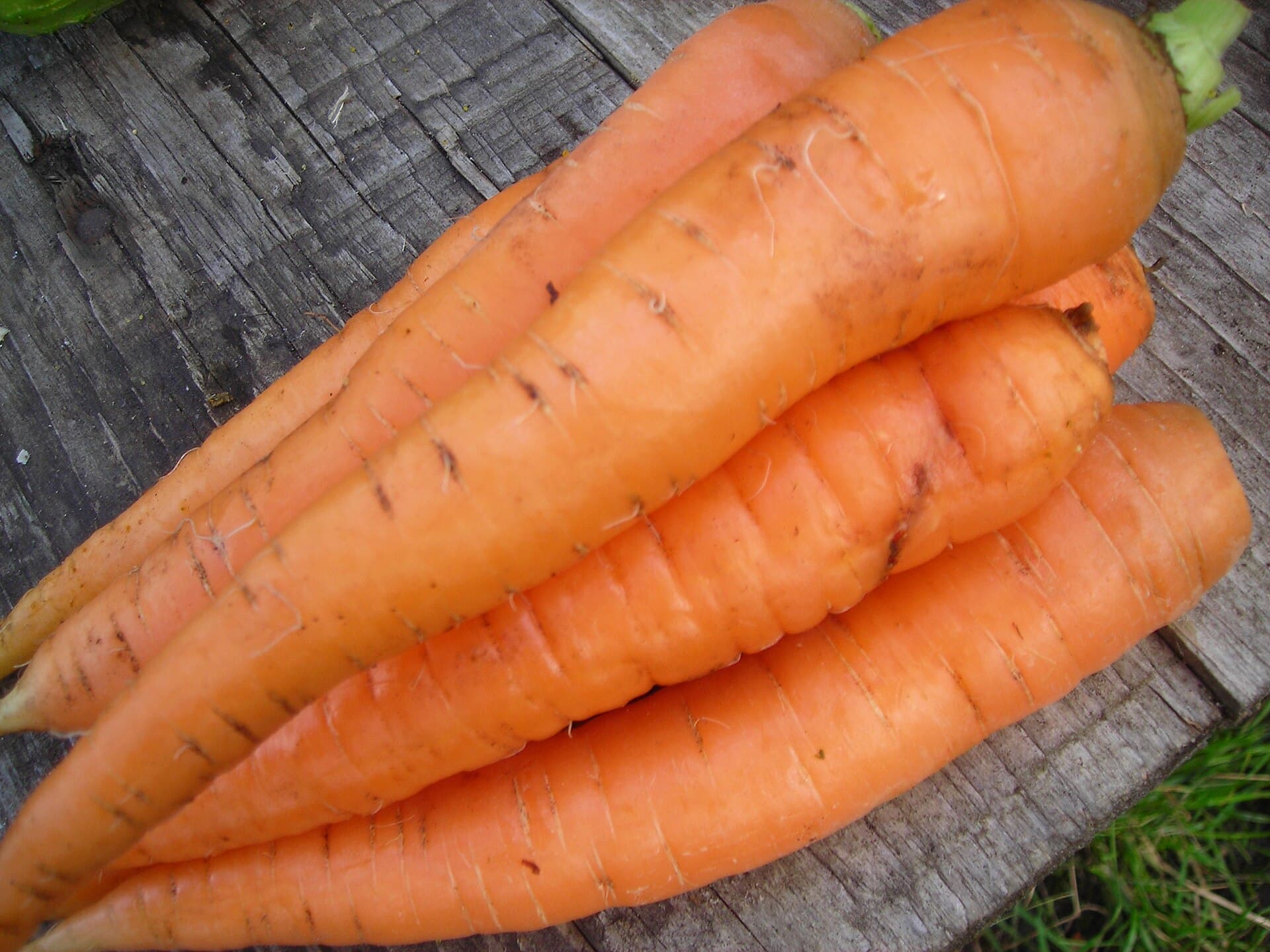
Carrots grow straight and sweet in loose, deep soil, and once they are up they need little care. The weak point is the first few weeks: the seed is slow to sprout, and a seedbed that dries out or crusts over, even once, leaves a patchy row. Keep it moist until the tops show, then thin without mercy.
At a glance
- Water: Medium
- Days to maturity: 60 to 80 days
- Spacing in the row: 2 to 3 in (5 to 8 cm), after thinning
- Spacing between rows: 12 in (30 cm)
- Mature spread: 3 in (8 cm)
- Mature height: 12 in (30 cm)
- Plants per square foot: 16
- Good neighbors: onion, leek, rosemary, sage, lettuce, tomato
- Keep apart from: dill, parsnip, fennel
When to plant
Carrots are a cool-season crop, and you sow them where they will grow, because moving a seedling damages the taproot. Work from your average last spring frost and first fall frost dates, which your state's cooperative extension service can give you; a hardiness zone is a winter low, not a frost date, so it cannot set your sowing dates. Sow spring crops from about 3 weeks before your average last frost to about 3 weeks after it, as soon as the soil can be worked. Sow fall crops 10 to 12 weeks before your first fall frost; the roots sweeten after a light frost. Seed sprouts poorly in soil warmer than about 85°F (29°C). Sow a short row every 2 to 3 weeks for a steady supply.
Real calendars differ from one region to the next. Clemson Extension, for example, has fall carrots sown from July 1 to 30 in the Piedmont of South Carolina, from August 1 to 15 in the central part of the state and from August 1 to 20 on the coast.
Where and in what soil
Give carrots full sun, at least 6 hours of direct light a day; they prefer 8 to 10. They tolerate some shade. Loosen the soil 12 inches (30 cm) deep and remove stones and clods, because a root that meets an obstacle forks. Sandy loam is ideal; in heavy clay, use a raised bed. Aim for a pH of 6.0 to 6.8, and skip fresh manure, which makes roots hairy and forked.
Planting
Sow seed 1/4 inch (6 mm) deep in rows 12 inches apart and cover lightly with fine soil. Keep the surface evenly moist with light, frequent watering until seedlings appear, which can take 1 to 3 weeks.
Thin when seedlings are about 2 inches (5 cm) tall, to 2 to 3 inches (5 to 8 cm) apart. Snip the extras at the soil line with scissors rather than pulling them, which disturbs the roots left behind. In a square-foot bed, plant 16 per square foot.
Care
Water. Once the tops are up, give carrots about 1 inch (2.5 cm) a week, more in heat. Long dry spells followed by a soaking crack the roots.
Weeding and mulch. Weed by hand while the seedlings are small, since they compete poorly. After thinning, mulch lightly with straw or shredded leaves to hold moisture.
Feeding. Carrots need little. Work compost into the bed before sowing, and skip high-nitrogen fertilizer, which grows tops at the expense of roots.
Covering shoulders. If the top of a root pushes out of the soil, cover it with soil or mulch. Light turns it green and bitter.
Good neighbors, and plants to keep apart
Most companion advice for carrots is what gardeners report from experience. Plant good neighbors within about 2 feet (60 cm) and keep poor ones at least 4 feet (120 cm) away.
Good neighbors
- Onion and leek: gardeners report that they mask carrots from the carrot fly.
- Lettuce, tomato, rosemary, sage, chives, garlic, scallion, shallot, peas, peppers and beans: gardeners report that they help.
Keep apart
- Parsnip: the two share a pest.
- Fennel: said to stunt the growth of neighboring plants.
- Dill: gardeners advise keeping it away from carrots.
Pests and problems
Carrot rust fly. Rust-brown tunnels in the roots, with pale larvae inside, and seedlings that wilt or stall. Cover the bed with floating row cover at sowing and leave it on, rotate the bed each year, and remove thinnings from the garden, since gardeners report that their scent draws the fly.
Forked, hairy or stunted roots. Stones, compacted soil, fresh manure and too much nitrogen are the usual causes. Loosen the bed deeply before sowing and fix the soil for the next crop; roots that have already forked will not straighten.
Split roots. A heavy watering after a dry spell makes roots swell faster than their skins can stretch. Water evenly and mulch.
Leaf blight. Dark spots on the leaves, which yellow and die back in warm, wet weather. Water at the base, remove infected leaves and rotate beds. A fungicide labeled for carrots is the last step; follow the label.
Harvest and storage
Check from about 60 days: brush the soil from a shoulder, and pull when the root is about 3/4 inch (2 cm) across, or whatever size suits the variety. Loosen the soil with a fork first so the tops do not snap. Twist off the tops 1 inch (2.5 cm) above the root, since leaves draw moisture from it.
Unwashed carrots keep for several weeks in a plastic bag in the refrigerator. Where winters are cold, you can leave fall carrots in the ground under a heavy layer of straw or shredded leaves and dig them as needed until the soil freezes hard. For longer storage, pack them in damp sand in a cold, humid place at 32 to 40°F (0 to 4°C).
Common questions
Why won't my carrots sprout?
Usually the surface dried out, because the seed needs constant moisture for 1 to 3 weeks. Soil that is too cold (below about 45°F, 7°C) or too hot (above about 85°F, 29°C) also stops it, as does a crust forming over the seed after heavy rain.
Can I grow carrots in a container?
Yes, in one at least 12 inches (30 cm) deep with drainage holes. Choose short, stubby types, fill it with loose potting mix and thin as you would in the ground.
Do carrots get sweeter after a frost?
Yes. Cold weather turns some of the starch in the roots to sugar, which is why fall carrots, and those left in the ground under mulch, taste sweeter.