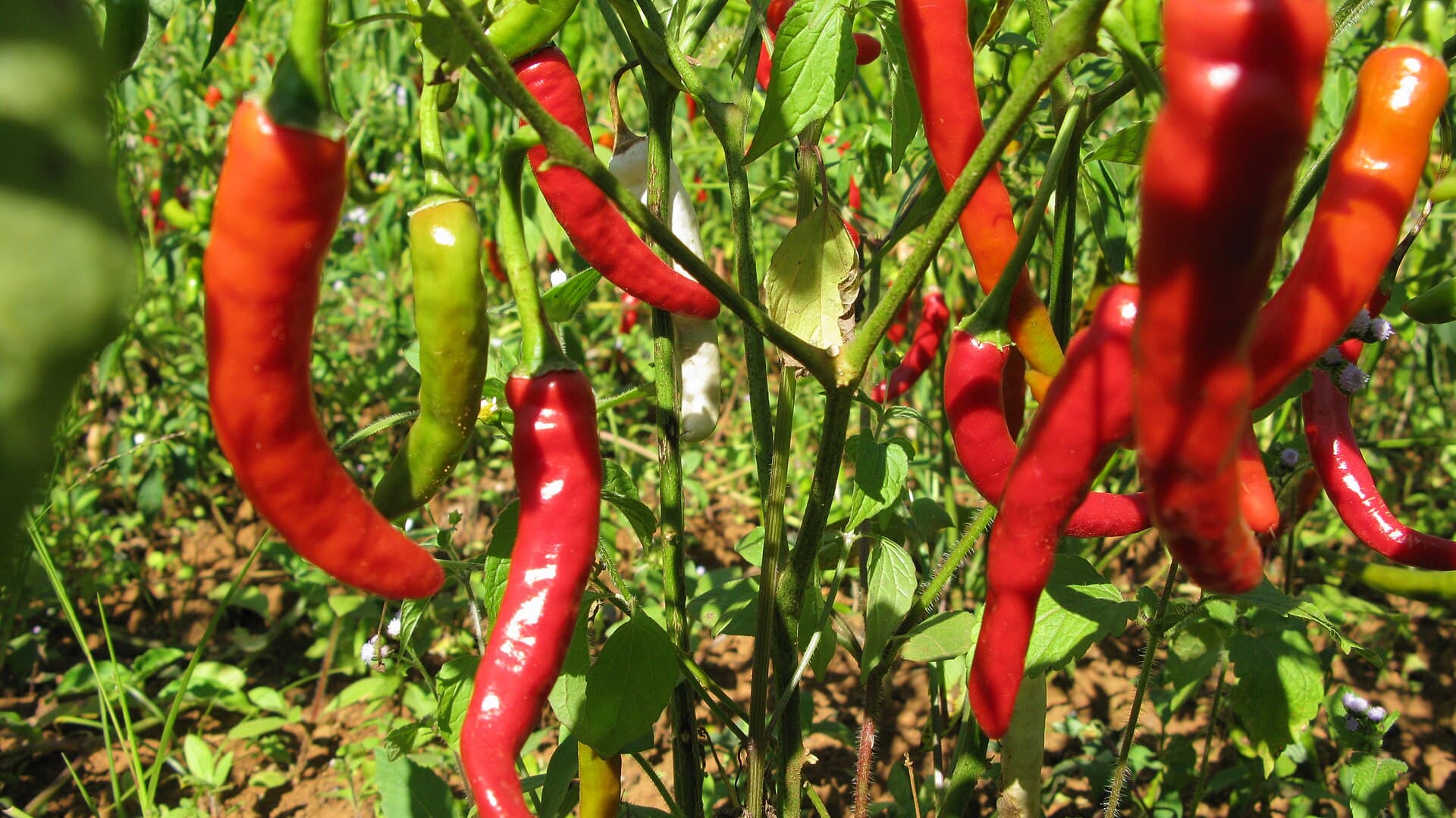
Hot peppers, or chiles, are Capsicum plants whose fruit carries capsaicin, the compound behind the burn. Five species are domesticated. Jalapeño and serrano belong to Capsicum annuum, the species of the bell pepper, while the hottest types, such as habanero, belong to Capsicum chinense and ask for more warmth and time. Success comes from matching the type to your season, then keeping the plants evenly watered and the fruit carefully handled. Oregon State Extension describes the species. For sweet types, see our bell pepper guide.
At a glance
- Light: Full sun.
- Water: Medium; aim for uniform soil moisture.
- Spacing in the row: 12 to 18 in (30 to 46 cm) between transplants.
- Spacing between rows: 18 to 24 in (46 to 61 cm) for peppers set out in rows.
- Good neighbors, by garden tradition: Basil and carrot.
- Keep apart, by garden tradition: Fennel and walnut.
When to plant
Look up your average last frost of spring and first frost of fall through your state extension service. Hot peppers are highly susceptible to frost, so delay transplanting until after that last frost and until the soil has warmed, since cool soil delays emergence and slows growth. Guides put the floor between 60°F (16°C) and 70°F (21°C). Illinois Extension explains the frost dates, and Georgia Extension gives the warmer soil temperature.
Match the chile to your season, because the hotter the variety, the longer it takes: most mature in 65 to 85 days from transplanting, habanero types in 90 to 120, according to Illinois Extension's blog and Maryland Extension.
Some cultivars want a frost-free season of at least 120 days. In Oregon, the hottest species, Capsicum chinense, can be difficult outdoors; a row cover, high tunnel or heated greenhouse gives the best crop, as Oregon State Extension explains.
Chiles grown in a home greenhouse need 6 to 8 weeks from seeding to reach transplant size, though some guides allow 8 to 10 weeks. Germinate seed at 80°F (27°C) until the root emerges, then grow seedlings on at 65 to 75°F (18 to 24°C). For direct seeding, guides range from 10 to 14 days before the last frost date to waiting until the soil has warmed, as New Mexico State Extension and Utah State Extension explain.
Where and in what soil
Plant hot peppers in full sun and well-drained soil of moderate fertility. Guides differ on pH, from 6.0 to 6.5 at Georgia Extension up to 7.0 to 8.5 in New Mexico.
Keep pots and beds away from patios, walkways and anywhere small children and pets can reach, because the compounds that give hot peppers their heat can painfully irritate eyes and skin, as Penn State Extension and UF/IFAS Extension describe.
For rotation, follow peppers with sweet corn to discourage Verticillium wilt, and with a cole crop such as broccoli or cabbage to reduce root-knot nematodes in sandy soil, as New Mexico State Extension suggests.
Planting
Start with transplants, which suit chile peppers best; direct seeding is for areas with a longer growing season. Harden seedlings off first by easing back on water and fertilizer for a few days, then exposing them gradually to sun, as South Dakota State Extension and Oregon State Extension explain; this avoids transplant shock and leaf sunscald. Plant in the early evening, water at once, and remove early flowers and fruit, which would stunt young plants.
Set chile plants 12 to 18 inches apart (30 to 46 cm) in the row, with rows 18 to 24 inches apart (46 to 61 cm), as Utah State Extension spaces the rows, though Georgia Extension allows plants as far as 24 inches apart (61 cm) in the row and leaves rows about 3 feet apart (91 cm). In New Mexico plants stand closer, 8 to 14 inches apart (20 to 36 cm).
Warm the soil early with black plastic mulch, particularly in northern New Mexico, and swap in straw or a similar mulch when the weather warms, which keeps the soil cooler. New Mexico State Extension describes both mulches.
Care
What changes the heat. A stressed plant makes more capsaicin, within limits: high temperatures and drought are the strongest stressors, though a jalapeño can never be made as hot as a habanero. For hotter fruit, Penn State Extension suggests lean soil and watering only when necessary; for predictable heat, use moderately rich soil and water evenly.
Water and feeding. Stressing plants for heat can cost you fruit, since under-watering can cause blossom shed, smaller fruit and blossom end rot, so water evenly; drip irrigation is the most efficient way to do it. Go easy on nitrogen, which gives leafy growth at the expense of fruit, as New Mexico State Extension advises.
Good neighbors, and plants to keep apart
Hot peppers have long been planted beside basil and carrot and kept away from fennel and walnut. Those pairings are garden tradition; sun, spacing, rotation and access come ahead of them.
Pests and problems
Fallen buds and blackened fruit. Suspect the pepper weevil, which survives the winter in warm areas such as Florida and Texas: infested buds and blossoms fall, and infested peppers blacken inside and fill with frass. Avoid buying plants grown where the weevil is a problem, as NC State Extension advises.
Yellowing, stunted or suddenly wilting plants. Yellow leaves on plants that stop growing may mean curly top virus or a wilt disease; infected plants have no known control, so destroy them. Over-watering can cause Phytophthora root rot, which makes plants wilt and die suddenly, so water with care; drip irrigation and raised beds lower the risk. In New Mexico, the beet leafhopper spreads curly top, so cover young plants early with row covers. Utah State Extension and New Mexico State Extension cover these problems.
Leaf and fruit problems. Aphids crowd leaf undersides and leave crinkled, sticky foliage: wash them off with water, or, if you use insecticidal soap, follow the label. Tobacco hornworms, greenish caterpillars with a red horn, strip leaves, so pick them off by hand. A dark, sunken spot at the blossom end of fruit is blossom end rot; even moisture and restrained nitrogen help prevent it. Light brown or white patches on sun-exposed fruit are sunscald; a leafy canopy and shade cloth help prevent it, as Utah State Extension and Oregon State Extension describe.
Harvest and storage
For a green crop, pick fully developed, firm, crisp fruit before it changes color; otherwise let most hot peppers ripen to red, as New Mexico State Extension and Oregon State Extension describe.
Wear gloves to handle hot peppers, keep your hands from your nose and eyes, and wash your hands well afterward, because capsaicin irritates eyes, mucous membranes and skin. Store fresh peppers cool and humid; they keep 1 to 2 weeks in some guides and 2 to 3 weeks in others. Penn State Extension gives the precautions and Maryland Extension the longer storage time.
Common questions
Why are my chiles milder or hotter than the packet says?
A variety's heat is always a range, shaped by genetics and environment, as Penn State Extension explains. Ripeness matters, and water stress can raise heat while cooler weather can lower it.
Are the seeds the hot part?
Mostly not. The capsaicin sits in the white ribs and lining inside the fruit, concentrated at the stem end, as Illinois Extension describes, so removing the seeds and ribs cuts the heat. Extension guides disagree about the seeds themselves: one says they are not a source of heat, another that the heat is found in the seed.
Should I pick jalapeños green or red?
Jalapeños, and in some guides anchos, are usually picked green, though they mature red. A pepper gets hotter as it nears full ripeness, and light skin cracking on a jalapeño marks maturity, as Oregon State Extension and Penn State Extension note.