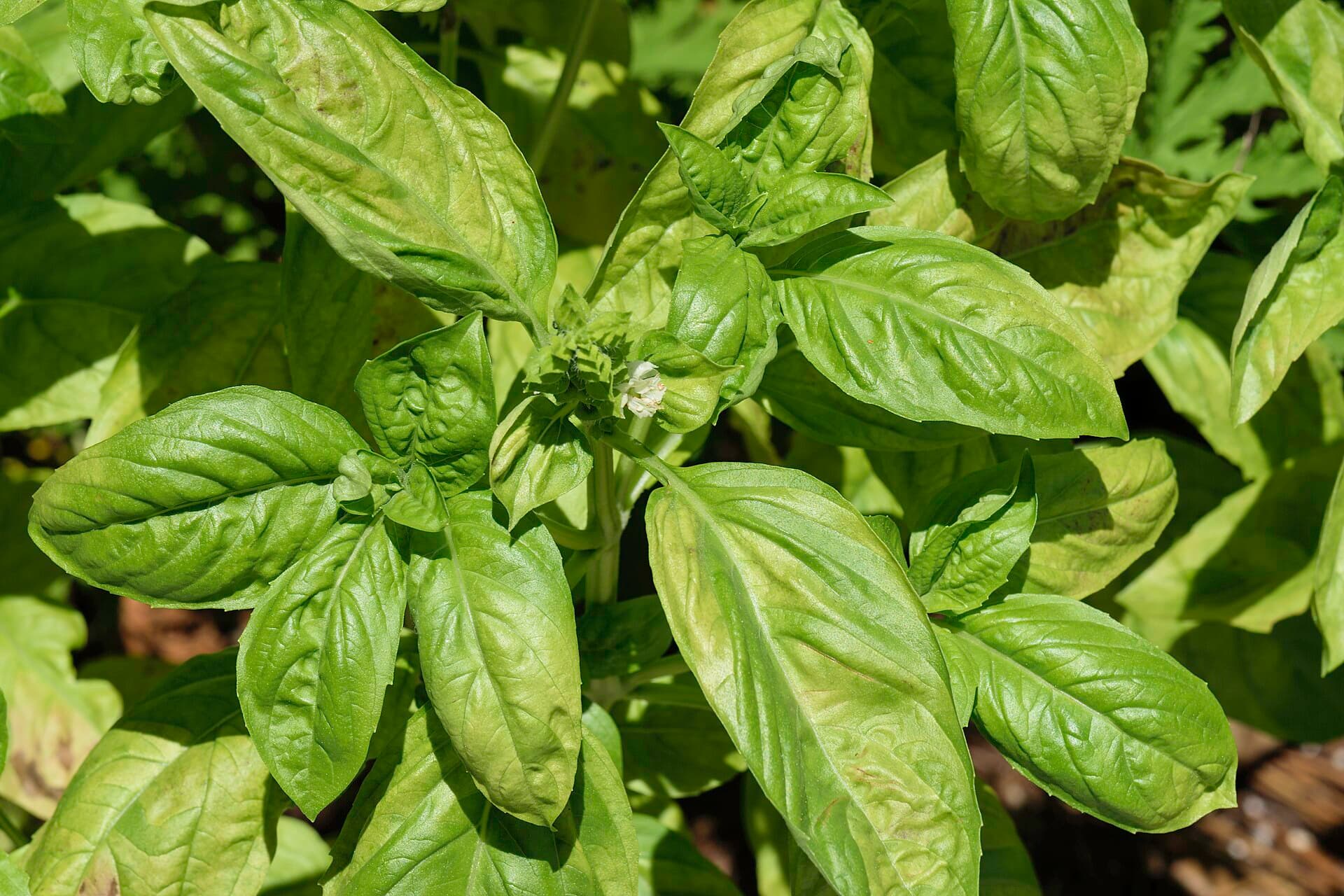
Basil rewards the gardener who picks it: a few plants give you leaves from early summer to frost, and every pinch makes them bushier. The common mistake is letting the flower spikes form, because the plant then puts its energy into seed, growth slows and the leaves lose flavor. Pinch tips early and often, and plant only when the nights are truly warm.
At a glance
- Sun: Full sun
- Water: Medium
- Days to maturity: 60 to 90 days
- Spacing in the row: 8 to 12 in (20 to 30 cm)
- Spacing between rows: 12 to 18 in (30 to 46 cm)
- Mature spread: 12 in (30 cm)
- Mature height: 18 to 24 in (46 to 61 cm)
- Plants per square foot: 1
- Good neighbors: tomato, pepper
- Keep apart from: rue, sage
When to plant
Basil is the most cold-sensitive herb in the garden. Nights below about 50°F (10°C) stunt it and frost kills it, though some sources set the minimum night temperature higher, as high as 60°F (16°C). Plant out 1 to 2 weeks after your last frost, once nights stay above 50°F (10°C), and expect the first fall frost to end the season. Your state's cooperative extension service can give you both dates; a hardiness zone, which reflects only the coldest winter temperature, cannot. Start seed indoors 4 to 6 weeks before planting out, 1/4 inch (6 mm) deep at 75 to 85°F (24 to 29°C); it sprouts in 5 to 10 days. You can also sow outdoors once the soil is warm. Sowing again every 3 or 4 weeks in early summer keeps tender young plants coming. In the hottest summers, afternoon shade keeps the leaves tender.
Where and in what soil
Give basil full sun, at least 6 hours a day, and a sheltered spot out of cold wind. It wants fertile, well-drained soil with a pH between 6.0 and 7.0; work in compost before planting. Basil also does well in pots: use fresh potting mix and a container at least 8 inches (20 cm) wide with drainage holes, and water when the top inch of soil feels dry.
Planting
Harden off indoor-grown seedlings for a week before planting out. Set them at the depth they grew in their pots, 8 to 12 inches apart in rows 12 to 18 inches apart. In a square-foot bed, plant one per square foot.
If you buy transplants, turn the leaves over and look for gray fuzz, and skip any plant with yellowing leaves, since downy mildew can arrive on nursery stock.
Care
Pinch early. When a plant is about 6 inches (15 cm) tall, pinch off the top just above a pair of leaves, so two new shoots grow in its place. Repeat as the plant grows. Pinch off flower buds as soon as they show.
Water. Give basil about 1 inch (2.5 cm) a week, at the base and in the morning. Wet leaves overnight invite mildew.
Mulch and feeding. Once the soil is warm, mulch lightly to hold moisture. Compost at planting is enough in the ground; potted plants can take a light feeding every 3 or 4 weeks.
Good neighbors, and plants to keep apart
Most companion advice for basil is what gardeners report from experience. Plant good neighbors within about 2 feet (60 cm).
Good neighbors
- Tomato: extension guidance on companion planting lists basil, along with marigold, against thrips on tomatoes.
- Peppers, sweet and hot: gardeners report that they help.
Keep apart
- Rue and sage: gardeners advise keeping them away from basil.
Pests and problems
Downy mildew. Leaves turn yellow between the veins, and gray-purple fuzz grows on the undersides. It spreads fast in humid weather and has no cure. Pull infected plants, give the rest room for airflow, water at the base in the morning and look for resistant varieties.
Japanese beetles. Metallic green and copper beetles chew leaves into lace in summer. Knock them into a bucket of soapy water in the morning, when they are sluggish.
Aphids. Clusters of tiny insects under the leaves, which curl and turn sticky. Knock them off with a strong spray of water, and repeat every few days.
Fusarium wilt. A plant wilts suddenly, and its stem shows dark streaks. It lives in the soil and can come in on seed. Pull the plant, plant basil elsewhere next year and choose resistant varieties.
Harvest and storage
Start picking when plants are about 6 inches (15 cm) tall. Cut from the top, just above a pair of leaves, and take no more than about a third of a plant at a time. Pick in the morning for the best flavor, and harvest everything before the first fall frost.
Sources disagree on refrigerating fresh basil. Three extension sources store it in a bag in the refrigerator, and two of them say it keeps for a week to 10 days; another calls basil chill-sensitive and says to keep it above 50°F (10°C). Or stand the stems in a glass of water at room temperature, out of direct sun, and the leaves keep for several days. Pesto freezes well in small portions.
Common questions
Why is my basil going to seed?
Basil flowers when it matures, and heat and stress speed it up. Pinch off the flower buds and cut the plant back by about a third; it will branch and make new leaves. Plants that have fully flowered make few leaves, so replace them with a new sowing.
Can I grow basil indoors?
Yes, in a bright south-facing window or under a grow light that runs 10 to 12 hours a day, and in a warm room. Water when the top inch of soil is dry, and pinch it as you would outdoors. Growth is slower in winter.
Why are my basil leaves turning black?
Cold is the usual cause: nights below 50°F (10°C), or chilling after picking. Yellowing with gray fuzz underneath points to downy mildew instead.