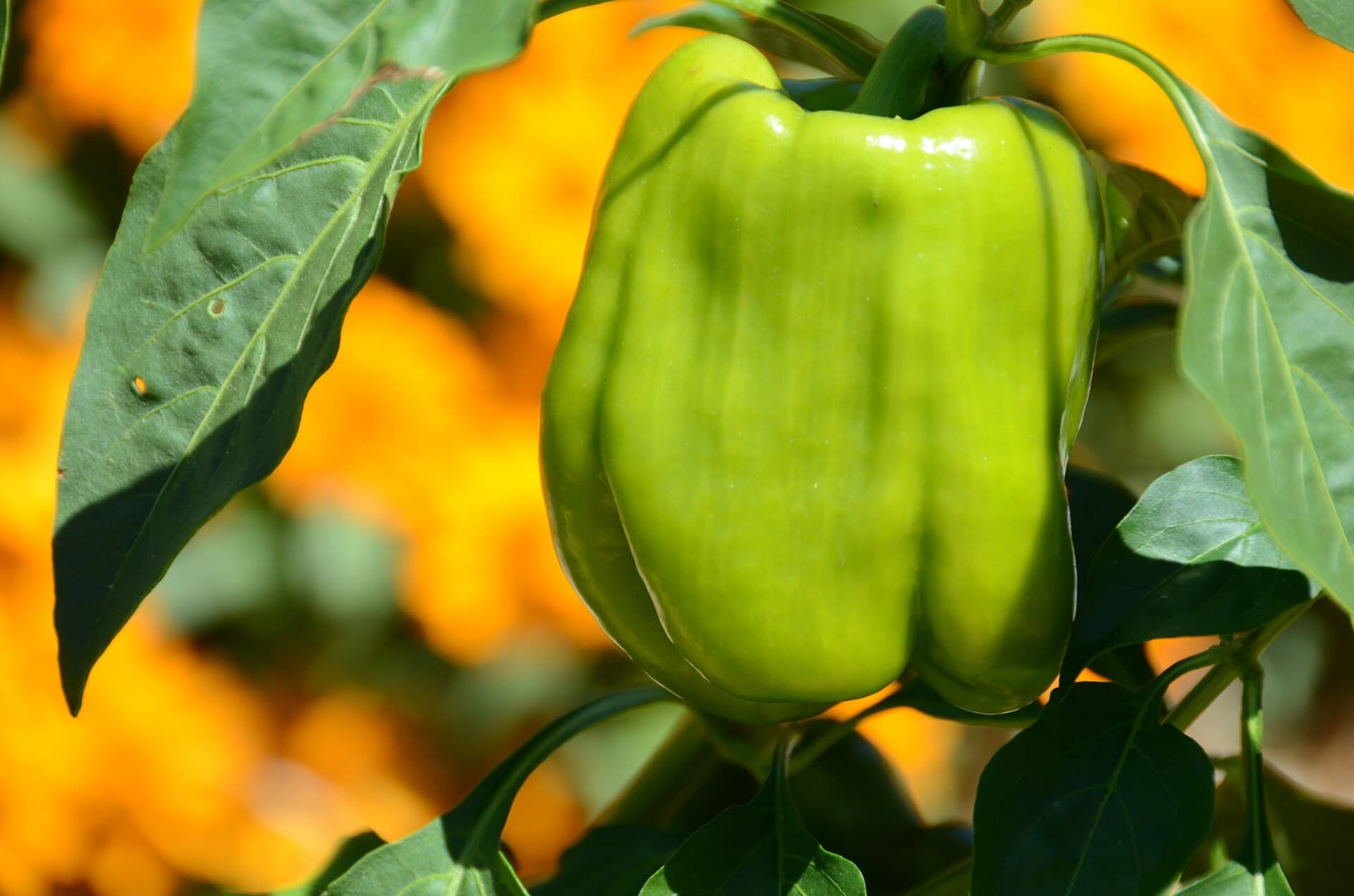
A bell pepper is the sweet, nearly heatless pepper with a large, blocky fruit, thick walls and three or four lobes. Most start green; you can pick them then or leave them to ripen to red, yellow, orange, brown or purple, depending on the cultivar. Peppers grow slowly in cool weather, so success comes from warm soil at planting, even moisture and enough warm weeks for the fruit to ripen. Oregon State Extension describes the bell group. Chile types have their own hot pepper guide.
At a glance
- Light: Full sun: direct light for at least 6 hours a day, ideally 8 to 10.
- Water: Medium; the soil should stay evenly moist without turning soggy.
- Spacing in the row: 12 to 18 in (30 to 46 cm) for transplants in rows.
- Spacing between rows: 18 to 24 in (46 to 61 cm) for rows of transplants.
- Good neighbors, by garden tradition: Basil, onion, carrot and marigold.
- Keep apart, by garden tradition: Fennel, beans, brassicas and walnut.
When to plant
Plan from the average last spring frost and the average first fall frost, dates your state extension service can supply. Peppers are warm-season plants, so set them out well after that last frost; Illinois Extension gives mid-May as the cautious date in central Illinois.
Set transplants out only once frost danger has passed and the soil is warm. Extension guides differ on how warm, from 60°F (16°C) up to 70°F (21°C), and plants set into soil under 65°F (18°C) just sit there. Oregon State Extension and Georgia Extension give the two ends.
Most gardeners find buying transplants easier. To raise your own, sow seed indoors 6 to 10 weeks before transplanting; extension guides differ, from 6 to 8 weeks up to the 8 to 10 that Utah State Extension allows.
Counted back from the average frost-free date instead, Maryland Extension starts seed 8 to 10 weeks ahead, and some types need 12 weeks.
Weigh the packet's days to harvest against your frost-free season, as Oregon State Extension advises: some cultivars need a season of at least 120 days, and a greenhouse, plastic mulch or row covers add warmth.
Where and in what soil
Give peppers full sun and well-drained soil, because they do poorly in heavy, wet soil. Use a raised bed where drainage is poor, and give a container at least 5 gallons, as Maryland Extension and Utah State Extension recommend.
Rotate: keep peppers out of beds where tomatoes, eggplant or potatoes grew the year before, and grow peppers, or other plants of their family, in any one spot no more often than every other year, according to South Dakota State Extension and Georgia Extension.
Planting
Choose stocky, dark green transplants with 6 to 9 leaves, and pick off any flowers or fruit before planting, since plants carrying them establish slowly and yield poorly. Harden home-grown plants off first, then plant on a cloudy day or in the evening and water well. Utah State Extension describes the transplants to pick, and Oregon State Extension the hardening and planting.
Space plants 12 to 18 inches (30 to 46 cm) apart in the row, or as far as 24 inches (61 cm), according to South Dakota State Extension and Georgia Extension. Rows can be as close as 18 to 24 inches (46 to 61 cm), while other extension guides leave 24 to 36 inches (61 to 91 cm).
Care
Water and mulch. Water evenly, about 1 to 2 inches (2.5 to 5 cm) a week from rain and watering, by drip line where you can, and avoid soggy soil, which invites root rot, as Utah State Extension and South Dakota State Extension point out. Black plastic mulch warms the soil early, but keep stems off it to avoid heat injury; lay organic mulch only once the soil is warmer than 75°F (24°C).
Feeding and support. Feed to a soil test and go easy on fertilizer, because too much encourages leafy growth and holds back fruit set and maturity. Support brittle stems with cages or short trellises, as Maryland Extension suggests.
Good neighbors, and plants to keep apart
Gardeners traditionally plant basil, onion, carrot or marigold near peppers, and some keep fennel, beans, brassicas and walnut away. Treat those as tradition, not pest control, and settle sun, spacing, rotation and access first.
Pests and problems
Curled, sticky leaves. Check leaf undersides for aphids, soft-bodied insects that crinkle leaves, leave sticky honeydew and can spread viruses. Knock them off with a strong stream of water, or use insecticidal soap and follow the label, as Utah State Extension describes.
Chewed leaves. Handpick hornworm and fruitworm larvae, which defoliate plants, damage fruit and leave black droppings; Utah State Extension calls hand removal an easy control. For a heavy infestation, Bt or another insecticide is an option; follow the label.
Dark, leathery spot on the fruit's bottom. This is blossom end rot, which Utah State Extension links to uneven watering. Keep moisture uniform, especially while plants flower.
Pale or light-brown patches on exposed fruit. This is sunscald. Harden transplants off, shade fruit from the hottest afternoon sun and encourage good leaf growth to cover it, as Oregon State Extension recommends.
Wilting plants with dark crown lesions. Suspect Phytophthora blight, which thrives in wet, saturated soil. Grow resistant varieties in well-drained raised beds, water by drip and keep overhead water off fruiting plants, according to NC State Extension; home gardeners have no effective chemical control, and rotation helps less because tomato, eggplant, snap bean and cucurbits are hosts too.
Mottled, curled, stunted leaves. These can be viruses, for which Oregon State Extension notes there is no treatment: remove affected plants and do not compost them.
Harvest and storage
Pick bell peppers once they are full size and firm, 60 to 85 days after transplanting or 80 to 100 from seed, and cut them from the plant instead of pulling, to avoid breaking branches. Leave fruit on the plant to color and sweeten. Georgia Extension and UF/IFAS Extension give the days and the picking advice.
At season's end, pick all mature green and slightly colored fruit. Fresh peppers keep 1 to 3 weeks in cool, humid conditions, 45 to 55°F (7 to 13°C), with extension guides split between 1 to 2 weeks and 2 to 3. Utah State Extension warns that long spells in the refrigerator risk chilling injury, while Georgia Extension advises storing peppers there, at 45°F (7°C).
Common questions
Why are my bell peppers still green?
Most bells start green and color as they ripen, so leave the fruit on the plant. Most turn red and some yellow, orange, brown or purple, 2 to 3 weeks after the mature green stage, as Maryland Extension explains; a few types start white and never change.
Will hot peppers nearby make my bell peppers hot?
No: planting sweet types beside hot ones does not turn the sweet peppers hot, as Maryland Extension confirms. Insects can cross-pollinate peppers, so saved seed can give unpredictable plants unless they are screened or kept 500 feet (152 m) apart.
Why are my pepper plants dropping flowers?
Flowers may drop and fruit may not set when nights fall below 60°F (16°C), or 55°F (13°C) in some guides, or days climb above 90°F (32°C), and the problem usually fades as the weather improves. In very hot weather, especially when evening temperatures are above 75°F (24°C), plants slow down or stop producing peppers. Dry soil causes blossom drop too, and over-fertilizing delays fruit set, so water evenly and feed lightly. Utah State Extension and Oregon State Extension give the night and day thresholds.