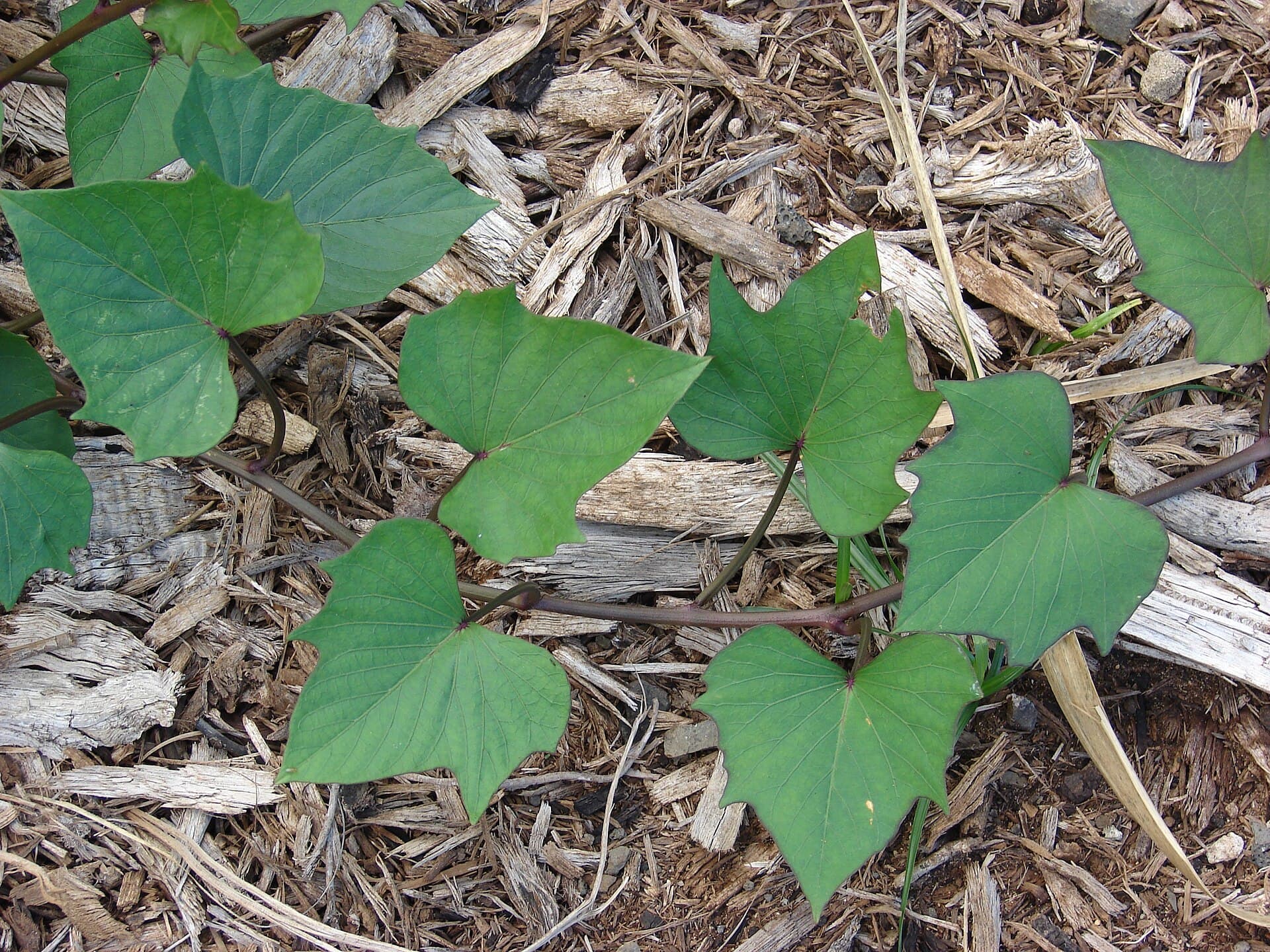
Sweet potatoes (Ipomoea batatas) are tender, trailing vines in the morning glory family, grown for their storage roots. The edible part is a true root, not a tuber, and the plant is not related to the potato. Gardeners grow it as an annual: plant slips, which are sprouts of a stored root, dig the roots before frost, and start the next planting from new slips. Success depends on a long stretch of warm weather and loose, well-drained soil.
At a glance
- Light: Full sun.
- Water: Medium; keep the soil evenly moist while slips establish, then water regularly.
- Days to maturity: 90 to 120 days from planting slips, depending on the variety.
- Spacing in the row: 12 in (30 cm), with slips set along a ridge.
- Spacing between rows: 36 in (91 cm), in ridged rows.
- Good neighbors, by garden tradition: Beans.
When to plant
Begin with your average last spring frost date and your first fall frost date, which your state extension service can give you, as Illinois Extension explains. Your county Extension office or the National Weather Service can confirm the last frost.
Wait until all danger of frost has passed and the soil, 4 inches (10 cm) down, is at least 65°F (18°C); one guide adds a wait of three to four weeks past the frost-free date, according to South Dakota State Extension and Penn State Extension.
Count on 90 to 120 days from planting slips, or at least 120, as UF/IFAS notes. In a short season such as South Dakota's, choose varieties of 90 to 100 days.
Where and in what soil
Give sweet potatoes at least 8 hours of full sun, though one guide calls for direct or partial sunlight, and keep the trailing vines away from taller plants that would shade them, as Mississippi State Extension and UF/IFAS describe.
Plant them in well-drained, sandy or loamy soil that is not too fertile: heavy clay or rocky soil gives misshapen roots, poor drainage may rot them, and over-fertilizing grows vigorous leaves and long, skinny roots. They grow best at pH 5.5 to 6.5, as Mississippi State Extension and New Hampshire Extension explain.
Planting
Buy slips from a reputable source, since certified disease-free stock helps avoid weevils, a serious problem in some coastal areas of the South, as UF/IFAS and NC State Extension note.
To start your own slips, lay mature roots on their sides in moist soil or sand, covering them with 1 to 2 inches (2.5 to 5 cm) or burying them halfway, and keep them warm at 75 to 80°F (24 to 27°C), or up to 85°F (29°C) in a covered bed. Begin six to eight weeks before planting, or about eight weeks before the last frost in one guide. Take the sprouts off at 4 to 6 inches (10 to 15 cm), or let them reach 8 to 12 inches (20 to 30 cm) in some guides; each root gives three to five slips, as Penn State Extension and New Hampshire Extension describe.
Make ridges 8 to 12 inches (20 to 30 cm) high and 12 inches (30 cm) wide, with rows 3 to 4 feet (91 to 122 cm) apart, or up to 6 feet (1.8 m) in one guide; ridges warm faster, drain better and make digging easier, as South Dakota State Extension and Mississippi State Extension describe.
Set slips about 12 inches (30 cm) apart on the ridge, or anywhere from 9 to 15 inches (23 to 38 cm), as Mississippi State Extension puts it, with at least two nodes buried and the leaves above ground. Plant on an overcast day or toward evening and water them in.
Care
Water new slips daily for the first two weeks, or keep the water steady for the first four to six weeks in one guide, then give 1/2 to 1 inch (1.3 to 2.5 cm) a week from rain or irrigation, as Mississippi State Extension and UF/IFAS note.
Mulch with compost, leaves or straw; the vines soon cover the ground and shade out most weeds. If you grow for roots, do not prune the vines, which can make roots sprout, and protect plants when temperatures fall below 50°F (10°C), as Penn State Extension and South Dakota State Extension advise.
Good neighbors, and plants to keep apart
Garden tradition pairs sweet potatoes with beans, including green beans. Treat that as tradition only, and put sun, ridges, rotation and access first.
Pests and problems
Deer and voles. Fence out deer, which browse the foliage to the ground and cut yields; a lightweight electric fence may keep them out. Keep weeds down and the area mowed or tilled to reduce vole damage, as New Hampshire Extension advises. Raised beds or large containers may keep rodents out.
Scurf and rot. Scurf shows as dark spots on the skin; it is superficial but can keep spreading in storage. Black rot decays the root. Use disease-free slips and let the soil dry between waterings, since wet soil promotes root rot. Rotate crops so that sweet potatoes do not return to the same ground for at least two years, or on a four-year rotation against scurf, as Penn State Extension and Mississippi State Extension suggest.
Beetles and larvae. Flea beetles chew narrow grooves in leaves, and their larvae etch shallow, winding tunnels across the root surface; floating row covers help protect plants. Wireworms can be an issue where the ground was sod or weedy with perennial grasses the year before, and they leave large shallow cavities and later deep, ragged holes. In some coastal areas of the South, the sweet potato weevil leaves small holes at the stem end and makes roots bitter. NC State Extension describes the pests, and South Dakota State Extension the row covers.
Harvest and storage
Dig before a killing frost, when the leaves begin to yellow, and before the soil drops below 60°F (16°C): a hard frost can damage roots near the surface, and soil below 50°F (10°C) brings root rot. Loosen the soil with a fork and handle the roots gently, since bruised roots keep poorly. Do not wash them; let them dry a few hours, as Penn State Extension and Mississippi State Extension set out.
Cure the roots after digging to heal wounds, at 80 to 90°F (27 to 32°C) and 85 to 90 percent humidity for 4 days to 2 weeks, or about 95°F (35°C) for about 10 days in one guide, as New Hampshire Extension and UF/IFAS show.
Store the cured roots in a cool, dark place at 55 to 60°F (13 to 16°C), or 50 to 60°F (10 to 16°C) in some guides, and never in the refrigerator. Temperatures below 50°F (10°C) can damage the roots, and one guide warns of chilling injury below 55°F (13°C) over long periods; properly cured roots can keep for months, as South Dakota State Extension notes.
Common questions
Can I start slips from a grocery-store sweet potato?
Start with organically grown roots if you can: store-bought sweet potatoes are often treated to stop sprouting and sprout poorly, as South Dakota State Extension warns. One guide still starts slips from a grocery-store root.
Why are my sweet potatoes long and skinny, or mostly vine?
Over-fertilizing is one cause: it gives vigorous leaf growth and long, skinny roots, and soil high in nitrogen may give plants with many leaves but few potatoes, as New Hampshire Extension explains.
Can I grow sweet potatoes in a short, cool summer?
Yes, with care. In a short, cold season like North Dakota's, choose the earliest-maturing variety, grow your own slips, use a raised bed with black plastic, and add row covers for extra heat, as NDSU Extension describes.