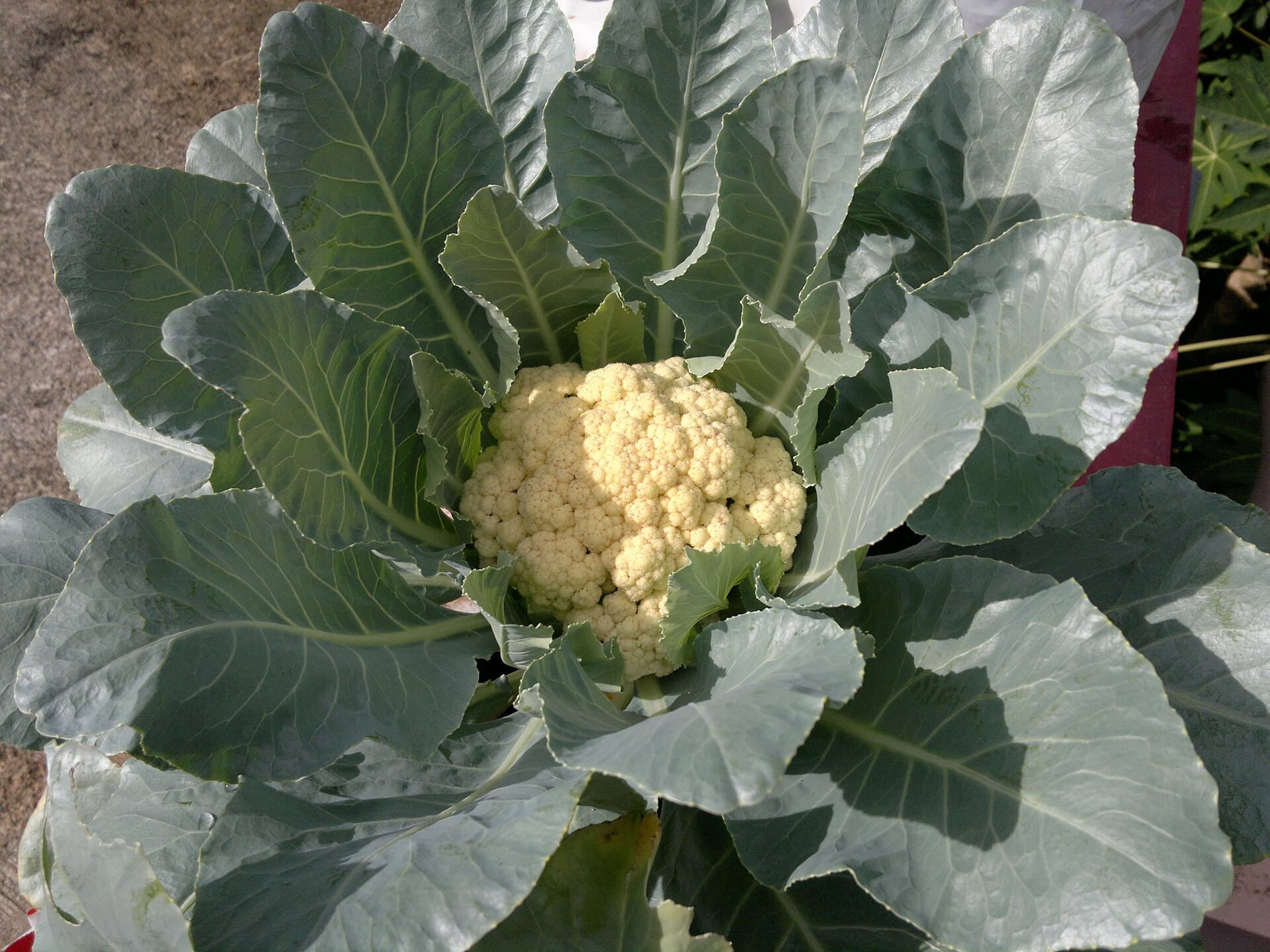
Cauliflower asks for steady growth. The edible head, called a curd, is a dense cluster of developing flowering stems. If the plant is stressed while it builds leaves, the curd may remain tiny; if harvest waits too long, its surface becomes loose and grainy. Minnesota Extension describes the curd and its cool-weather preference.
At a glance
- Light: Full sun, at least 6 hours of direct light; 8 to 10 preferred.
- Water: Medium; provide even moisture throughout growth.
- Spacing in the row: 18 in (46 cm) for a typical planting; allow more room for large cultivars.
- Spacing between rows: 24 in (61 cm) in a compact conventional layout; wider paths may be useful.
- Good neighbors, by garden tradition: Beans, celery and onion.
- Keep apart, by garden tradition: Strawberry and tomato.
When to plant
Start with the average last spring frost and first fall frost dates for your garden; your state extension service can help locate them. Illinois Extension explains that both frost timing and time to maturity shape a planting plan. Cauliflower curds develop best in cool weather, about 50 to 70°F (10 to 21°C), according to Minnesota Extension. Time spring transplants to finish before summer heat, or start a fall crop so the curds grow as weather cools.
For spring, raise plants indoors and set out sturdy transplants. Maryland Extension describes setting five- to seven-week-old plants out three to four weeks before the local frost-free date, but warns that setting stressed or overmature plants out too early can produce button heads. For a fall crop, grow transplants or direct sow where the season is long enough. Do the math from the first fall frost and your cultivar's packet, allowing time for indoor seedling growth if transplanting.
Maryland gives 50 to 80 days from transplanting, depending on cultivar. That is not 50 to 80 days from sowing seed. Maryland Extension supplies the transplant figure; Minnesota Extension notes that some fast cultivars suit spring while most types do well for fall harvest.
Where and in what soil
Give cauliflower full sun and fertile, well-drained soil that retains moisture. Minnesota recommends a soil pH of 6 to 7 and a soil test before adding nutrients. The plants must absorb water and nutrients steadily to make a dense curd. Leave enough room to water, inspect and eventually shade a white head. Minnesota Extension covers these needs; Maryland Extension gives the sunlight target.
Avoid a bed that recently held cabbage, broccoli, kale or another cabbage-family crop. Minnesota advises a four-year break for related crops in the same place.
Planting
Sow seed indoors in clean seed-starting mix, 1/4 to 1/2 inch (6 to 13 mm) deep. Give seedlings bright light after emergence. Once they have four or five true leaves, gradually expose them to outdoor conditions over about a week while keeping them watered. Handle the roots gently; set transplants at the level they grew in their pots, about 18 inches (46 cm) apart, and water them in. Minnesota Extension gives these seed and transplant steps. Maryland allows 18 to 24 inches (46 to 61 cm) between plants and 24 to 36 inches (61 to 91 cm) between rows, so check the mature needs of your cultivar and leave paths you can work from.
For fall direct seeding, sow about three seeds at each planned plant position, 1/4 to 1/2 inch (6 to 13 mm) deep, and thin to one strong seedling every 18 inches (46 cm). Keep the seedbed moist through emergence. Seedlings in summer face heat, drying wind and insect damage, so check them frequently. A well-anchored lightweight row cover can protect new plants from some insects; use a fabric suited to the temperature so the covered bed does not overheat. Minnesota Extension gives the sowing and cover guidance.
Care
Keep water steady. Cauliflower responds poorly to drought stress. Minnesota suggests soaking the soil if a planting has not received about 1 inch (2.5 cm) of rain in a week, more frequently in sandy soil. Use a trowel to check how deeply the soil is moist, then adjust to the weather and your soil. Mulch after plants are established to reduce weeds and moisture swings. Cultivate only shallowly so roots are not cut. Minnesota Extension describes these checks.
Shade white curds when needed. As a white head becomes visible, gather several outer leaves over it to keep strong sunlight from changing its color. Tie loosely enough for air to circulate and check the curd frequently; Maryland suggests beginning at about 2 inches (5 cm) across. Self-blanching white cultivars have leaves that naturally cover the head and may need no tying. Do not cover purple, orange, green or Romanesco heads: light helps them develop color. Here, blanching means shading a growing head, not a food-preservation step. Maryland Extension and Minnesota Extension explain the cultivar difference.
Good neighbors, and plants to keep apart
Beans, celery and onion are traditional cauliflower neighbors; strawberry and tomato appear on some gardeners' keep-apart lists. These are anecdotal pairings, not a demonstrated pest-control method. Place crops according to their own light and spacing needs first.
Pests and problems
Inspect both sides of leaves for imported cabbageworm, cabbage looper and diamondback moth larvae. Their chewing can leave holes; larger caterpillars may move toward the center and soil the curd. Check at least weekly after planting and more often as damage appears. Handpick visible caterpillars or use a securely fitted row cover before butterflies and moths lay eggs. Minnesota Extension's caterpillar guide gives these signs and controls. Maryland also lists flea beetles and harlequin bugs among cauliflower problems.
A curd that stops growing at about an inch (2.5 cm) across is called a button head. Overgrown transplants, hot or cold weather during head formation, and water or nutrient stress can contribute. Avoid holding seedlings too long, transplant carefully and keep growth even. A button head will not become a large, smooth curd simply by waiting. Maryland Extension describes this disorder; Minnesota Extension lists other stresses.
Harvest and storage
Cut a curd when it is firm, compact and a usable size, before flower sections loosen or open. Size varies by cultivar and growing conditions; a color type need not be white to be ready. Leave some surrounding leaves to protect the head while handling it. Unlike heading broccoli, cauliflower is grown for its one main curd rather than a sequence of side shoots. Maryland Extension gives the compactness cue; Minnesota Extension warns that curds left too long become loose.
Refrigerate the harvested head promptly and use it while firm. Minnesota estimates about one week in a household refrigerator.
Common questions
Do I have to tie leaves over every cauliflower head?
No. Shade a white cultivar if its leaves leave the curd exposed; self-blanching white types may cover themselves. Keep colored and Romanesco curds in the light so their color develops. Minnesota Extension distinguishes the types.
Why is the head small and grainy?
A very small head can be buttoning after stress before the plant made enough leaves. A curd that was once compact but is now loose or grainy may simply be past its best harvest stage. The sequence matters: review transplant age, temperature and moisture for buttoning, and cut future heads before the sections separate. Maryland Extension describes both signs.
Is fall easier than spring for cauliflower?
Often, but it depends on your climate. Maryland reports better fall success for many Mid-Atlantic gardens because spring temperature swings can cause buttoning. Minnesota notes that most types suit a fall harvest, while some short-season varieties work in spring. Choose a cultivar and planting window based on your local frost dates and expected cooling weather.