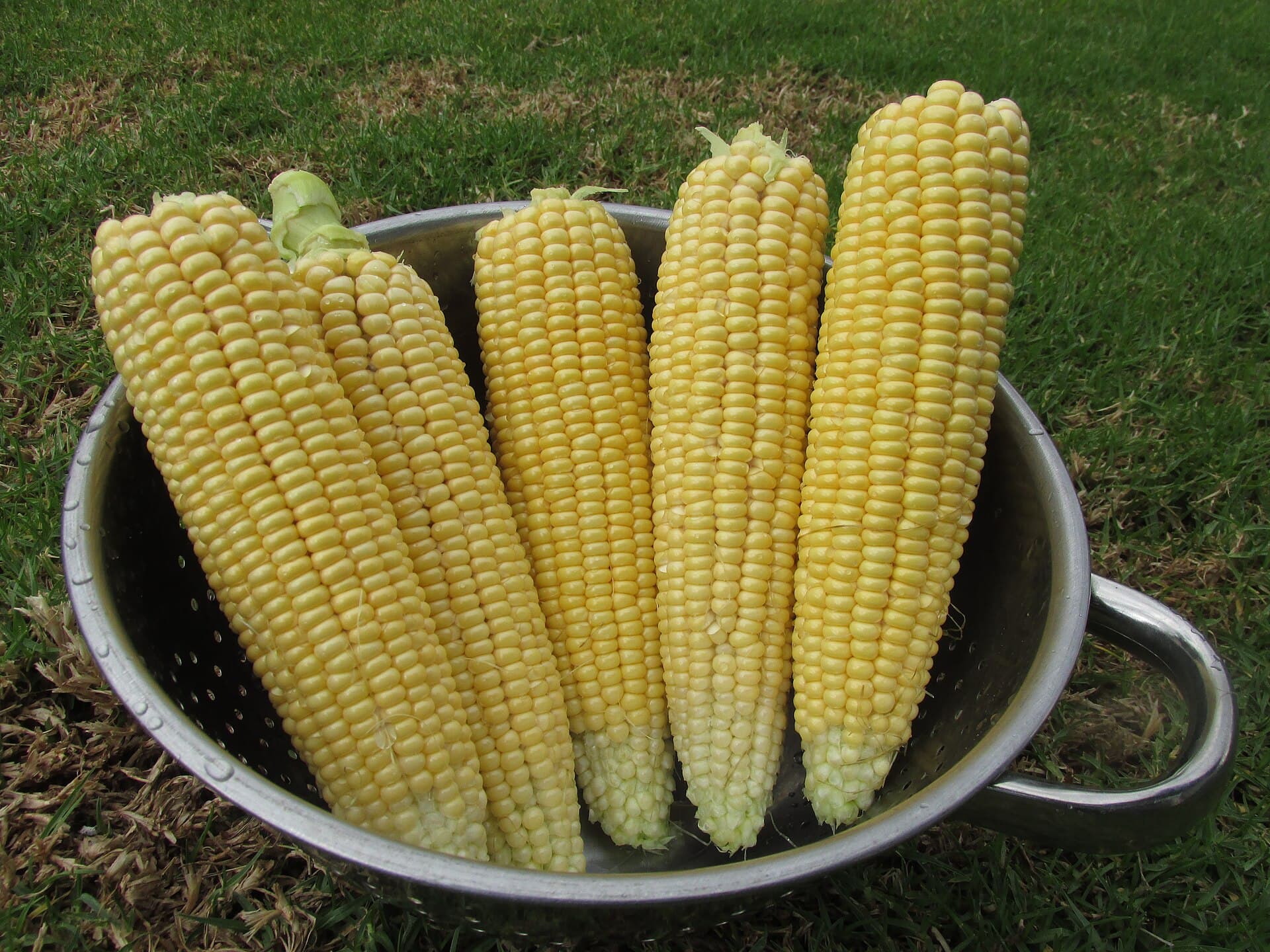
Sweet corn (Zea mays) is a tender, warm-season annual picked while the kernels are still immature. Seed packets carry code letters for its types: su (sugary), se (sugary enhanced), sh (supersweet) and sy (synergistic, a mix of those genes). Success depends on warm soil at sowing, a block of several rows so wind can pollinate the ears, steady water, and a short trip from stalk to refrigerator.
At a glance
- Light: Full sun.
- Water: High; steady moisture matters most from tasseling through ear fill.
- Days to maturity: 60 to 100 days, depending on the variety.
- Spacing in the row: 8 to 12 in (20 to 30 cm), for seed sown in rows.
- Spacing between rows: 30 to 36 in (76 to 91 cm), for rows planted as a block.
- Good neighbors, by garden tradition: Beans and squash.
- Keep apart, by garden tradition: Tomato.
When to plant
Start from your own frost dates: your state extension service publishes the typical date of the last frost in spring and of the first frost in fall, and planting dates depend on those dates and on the days to maturity on the seed packet. Sweet corn takes 60 to 100 days to mature, depending on the variety, and one guide counts 60 to 90 days from planting, as Illinois Extension's planting guide and Utah State Extension explain.
Sow once the soil reaches 50 to 60°F (10 to 16°C), though 60°F is better, as New Hampshire Extension advises; supersweet types want about 65°F (18°C).
Time the first sowing from your last frost date, from at or just before it for early standard corn to at least two weeks after it, according to Illinois Extension and Georgia Extension. For a longer harvest, sow a little more every 7 to 14 days, or when the last sowing's seedlings have three to four leaves.
Where and in what soil
Choose a spot with at least 8 to 10 hours of sun, though one guide gives 6 hours of direct light as the minimum, and room for a block of several short rows, in loamy, well-drained soil, as Georgia Extension and Maryland Extension describe.
Test the soil for lime and fertilizer needs and aim for a pH of 6.0 to 6.5, though Minnesota Extension gives 5.8 to 7.0.
Planting
Sow seed direct in the garden, about 1 inch (2.5 cm) deep, or 1/2 inch (1.3 cm) in cool, moist soil and up to 1 1/2 inches (3.8 cm) in warm, dry soil, as Illinois Extension advises, though supersweet seed goes no deeper than 1 inch.
Space seeds 8 to 12 inches (20 to 30 cm) apart, in rows 30 to 36 inches (76 to 91 cm) apart, or as close as 7 to 9 inches (18 to 23 cm) in rows 24 to 30 inches (61 to 76 cm), as Minnesota Extension and Utah State Extension describe.
Plant a block of short rows, at least three or four in most guides and two or more in one, not one long row, because wind carries the pollen and a single row loses much of it, leaving ears with blank patches, as Maryland Extension describes.
Keep supersweet and synergistic types 500 feet (152 m) or more away from other corn, as Georgia Extension advises; some guides say 400 yards (366 m). Cross-pollination gives starchy, tough kernels. You can also stagger plantings so that they mature a month apart; one guide separates them by two weeks of planting time. Sugary and sugary-enhanced types need no isolation from each other.
Care
Water at least 1 inch (2.5 cm) a week, most carefully from about two weeks before the silks form through ear fill. Keep the rows free of weeds with light, shallow tilling, staying well clear of the roots, then hill soil 2 to 3 inches (5 to 8 cm) high against the base of each plant, which steadies the stalks in wind, as Georgia Extension and New Hampshire Extension outline.
Side-dress nitrogen fertilizer when plants are 12 to 18 inches (30 to 46 cm) tall and again when tassels appear, as Maryland Extension advises, though guides give one to three doses. Run heavy string, one or two strands, around the planting's edge so thunderstorms cannot topple the plants.
Good neighbors, and plants to keep apart
Corn's traditional partners are beans and squash, in the Three Sisters planting. Treat that and every other pairing as garden tradition. Put sun, a block of rows and access to the ears first, then fit in green beans or zucchini and summer squash. Garden tradition also keeps tomatoes apart.
Pests and problems
Ear-tip caterpillars. The corn earworm and European corn borer both feed on developing ears, and a caterpillar near the tip with chewed kernels is common; cut off the damaged part and cook the rest. In Minnesota, sowing around early May with a variety that matures in under 80 days avoids problems from both. Once a worm is inside the husk, no control is effective. If you spray Bt or another insecticide for earworms, regular sprays are needed; follow the label. Minnesota Extension and Utah State Extension cover the caterpillars and the sprays.
Stalks. Corn borer larvae tunnel into stalks and tassels, which can break, and spend the winter in the stalks and stubble; plowing these under after harvest is an effective control. Removing plant debris also reduces diseases that may overwinter in old stalks, as Maine Extension and Georgia Extension report.
Smut and rust. Cut out smut galls, the firm growths on leaves, stems, ears or tassels, before they release spores; take them out of the garden and do not compost them. Leaf rust shows as orange streaks shedding powdery orange spores; rust-resistant varieties are the best control, as Minnesota Extension notes.
Birds and raccoons. Leave a floating row cover over the seedbed to discourage birds from eating the seed, until the plants emerge or, in one guide, until they are too large for the space under it, after three to four weeks. Raccoons are difficult to fence out, but an electric fence with two low strands, switched on before the ears ripen and kept clear of grass and weeds, may keep them away, as New Hampshire Extension and Illinois Extension describe.
Harvest and storage
Start checking about 20 days after the first silks appear; ears take 17 to 24 days, ripening faster in hot weather and slower in cool. Pick when the silks are dry and brown and the kernels are plump: a thumbnail puncture should give milky juice, since clear juice means too early and none means too late. The milk stage lasts less than a week, so check often, and snap each ear downward with a twist, as Illinois Extension and Maryland Extension detail.
Pick in the cool of morning or evening and refrigerate promptly, because sugar turns to starch faster when warm: ten times faster at 70°F (21°C) than at 32°F (0°C), as New Hampshire Extension shows. Keeping times run from 1 to 2 days to 2 to 3 weeks for newer types.
Common questions
Why are the tips of my ears bare?
Hot, dry weather during silking and pollination, plants too close together, low fertility and poor pollination all cause it. Water in dry spells, space plants as recommended, fertilize by soil test and plant a block of three or more rows, as Utah State Extension recommends.
Should I pull off the side shoots?
No: most suckers bear no usable ears, but removing them does not improve yields and has sometimes lowered them, according to Utah State Extension and Maryland Extension.
Why won't my corn come up?
Seed sown too early may give a weak stand, and in cooler soil disease is more likely to infect seed. Wait until the soil is above 60°F (16°C) and sow extra seed, then thin; supersweet seed does not germinate well in cold, wet soil, and untreated seed needs soil of at least 65°F (18°C), as Utah State Extension and Minnesota Extension note.