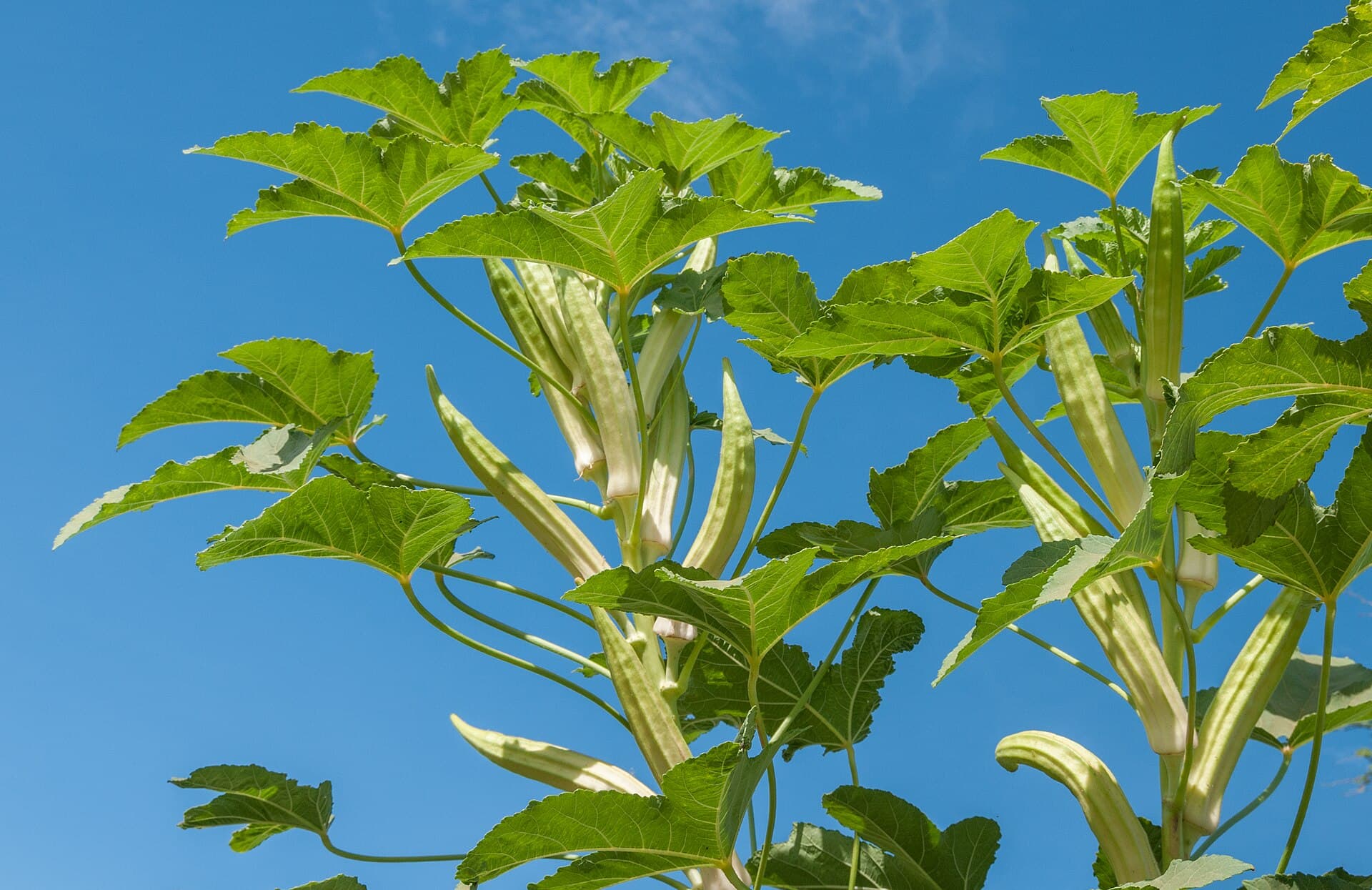
Okra (Abelmoschus esculentus) is a tall, warm-season annual in the mallow family, grown for its immature pods and its hibiscus-like flowers. Most cultivars reach 3 to 6 feet (91 to 183 cm), as Utah State Extension notes, though one guide gives 6 to 10 feet (1.8 to 3 m), and most varieties make spineless pods. Heat, young pods and frequent picking decide the harvest.
At a glance
- Light: Full sun.
- Water: Medium; tolerates dry spells, but water in prolonged dry weather, especially during flowering and pod development.
- Spacing in the row: 12 to 18 in (30 to 46 cm), in conventional rows.
- Spacing between rows: 36 in (91 cm), in conventional rows.
- Good neighbors, by garden tradition: Peppers and basil.
When to plant
Ask your state extension service for the usual dates of your last frost in spring and first frost in fall, and sow okra well after the last frost, once the soil has warmed, as Illinois Extension's planting guide and Georgia Extension advise. Check the soil 4 inches (10 cm) down: guides set the minimum at 65°F (18°C), or as high as 75°F (24°C). Sowing then falls a week to 10 days up to 2 to 3 weeks after your last frost. Illinois Extension's chart lists okra transplants for central Illinois from May 10 to June 15.
Sow seed in the garden once the soil is warm. For an earlier harvest, start seed indoors 5 to 6 weeks before frost danger is past, or, where the season is short, 4 to 5 weeks before transplanting, according to Maryland Extension and Utah State Extension.
Pods come about 50 to 60 days after transplanting, and 60 to 70 days up to 90 days after planting or seeding. Plants bear until frost kills them, and in Mississippi a second sowing about 6 weeks after the first keeps tender pods coming in late summer and fall, say Illinois Extension and Mississippi State Extension.
Where and in what soil
Choose full sun and well-drained soil, since okra does not tolerate wet soil. Okra tolerates a pH of 5.8 to 6.8, though one guide calls 6.0 to 7.0 ideal, and acid soils give poor pod development, as Utah State Extension and Georgia Extension explain.
Run rows east to west to catch the most sun, and leave extra space around paired rows for harvesting, as Georgia Extension and Mississippi State Extension advise. Rotate crops to help control root-knot nematodes and wilt.
Planting
Okra seed has a hard coat, so soak it for several hours or overnight before sowing, or scratch it with sandpaper or a rasp and soak it for 12 to 24 hours, as Georgia Extension and Maryland Extension describe.
Buy fresh seed each season, because okra seed does not keep well. Sow 1 inch (2.5 cm) deep and thin to 12 to 24 inches (30 to 61 cm) apart in rows 3 to 4 feet (91 to 122 cm) apart; if you sow in hills, thin each to the strongest plant. Four or five plants usually feed a family, as Illinois Extension notes.
Care
Okra tolerates dry spells, but keep it watered through flowering and pod development. Soak deeply every 7 to 10 days, using 1 to 1.5 inches (2.5 to 4 cm) of water in prolonged dry weather or 1.5 to 2 inches (4 to 5 cm) for maximum yields, early in the morning so foliage dries by night, as Georgia Extension and Utah State Extension advise.
Cultivate shallowly and mulch; planting through black plastic mulch promotes earliness. Go easy on early nitrogen, since too much builds leaves instead of pods. Side-dressing times differ: at least once after pods start to form; twice, when plants are 6 to 8 inches (15 to 20 cm) tall and again 2 to 3 weeks later; or when pods begin to size and again 4 weeks later. Pinch the growing points at 24 inches (61 cm) tall to promote branching. Mississippi State Extension and Maryland Extension give the mulch and pinching advice.
Good neighbors, and plants to keep apart
Gardeners traditionally plant peppers and basil near okra. Treat the pairings as garden tradition, not as pest control, and put sun, spacing, rotation and easy picking first. See our basil guide.
Pests and problems
Curled or warty pods. Stink bugs, more often injurious in the South, and leaffooted bugs pierce pods, which grow deformed with wartlike growths. Weeding thoroughly may reduce the bugs that overwinter near fields, though stink bugs from nearby woods or other areas cannot be avoided, according to NC State Extension.
Holes in pods or leaves. Corn earworms eat holes in pods, and where they occur Japanese beetles skeletonize leaves, though the damage is usually negligible unless numbers are unusually high. In most home gardens you can pick the beetles off by hand daily, says Illinois Extension.
Sticky, spotted leaves. Aphids cluster on leaf undersides and leave sticky sap and spotting. Dislodge them with a strong stream of water or insecticidal soap, and follow the label on any soap, as Utah State Extension advises.
Stunted or wilting plants. Root-knot nematodes stunt growth and gall the roots: rotate crops and remove damaged plants. Stunted, yellowing plants with brown, rotting roots point to root rot or damping off, so avoid planting in cold, wet, poorly drained soil. Midsummer yellowing, wilting and death can be Verticillium or Fusarium wilt, which okra does not resist, as Illinois Extension explains.
Harvest and storage
Pick pods while tender, at 2 to 3 inches (5 to 8 cm) long, though one guide lets them reach 5 inches (13 cm), as Georgia Extension and Utah State Extension advise. Pick every day or two, or at least every few days: large pods quickly turn tough, and a stem that is hard to cut means the pod is too old. Pods are ready about one to three days after a flower opens, and unopened flower buds are easy to mistake for pods.
Cut with pruners, and remove missed pods, since maturing pods slow production and old pods restrict further flowering. Wear gloves and long sleeves: plants can be spiny, their short hairs may irritate bare skin, and even spineless varieties cause some skin irritation, according to Illinois Extension and Mississippi State Extension.
Refrigerate pods unwashed, in a paper bag or loosely wrapped in a perforated plastic bag, as Maryland Extension and Illinois Extension describe, ideally at 45 to 50°F (7 to 10°C). They keep 2 or 3 days up to about a week and turn pitted after more than a week; one guide wants the pods dry and another a moist environment.
Common questions
Can I grow okra where summers are short?
Yes, with the right choices. Choose early maturing varieties, such as one listed at 60 days, and give seed a head start indoors in paper pots, which suit okra because it dislikes root disturbance. An exposed pot can wick moisture from the transplant and dry it out, so tear off the top inch (2.5 cm) of each pot at planting, as North Dakota State Extension describes.
Why won't my okra seed come up?
Okra seed has a hard coat, so soak or scratch it as above, and wait until the soil is at least 65°F (18°C), or 75°F (24°C) in one guide, at 4 inches (10 cm), because seedlings are sensitive to cool, wet soil and cool air, as Mississippi State Extension warns. Old seed may also fail.
What if my okra gets too tall to pick?
Cut tall plants back to 3 to 4 feet (91 to 122 cm) to promote branching, make picking easier and renew the plants, and side-dress at the same time. When hot, dry weather slows or stops flowering, cut stems to 6 to 12 inches (15 to 30 cm) instead, then fertilize and irrigate for new growth, as NC State's Union County Center describes. Next time, choose a dwarf or basal-branching type, such as Annie Oakley, which grows 2.5 to 5 feet (76 to 152 cm) tall.