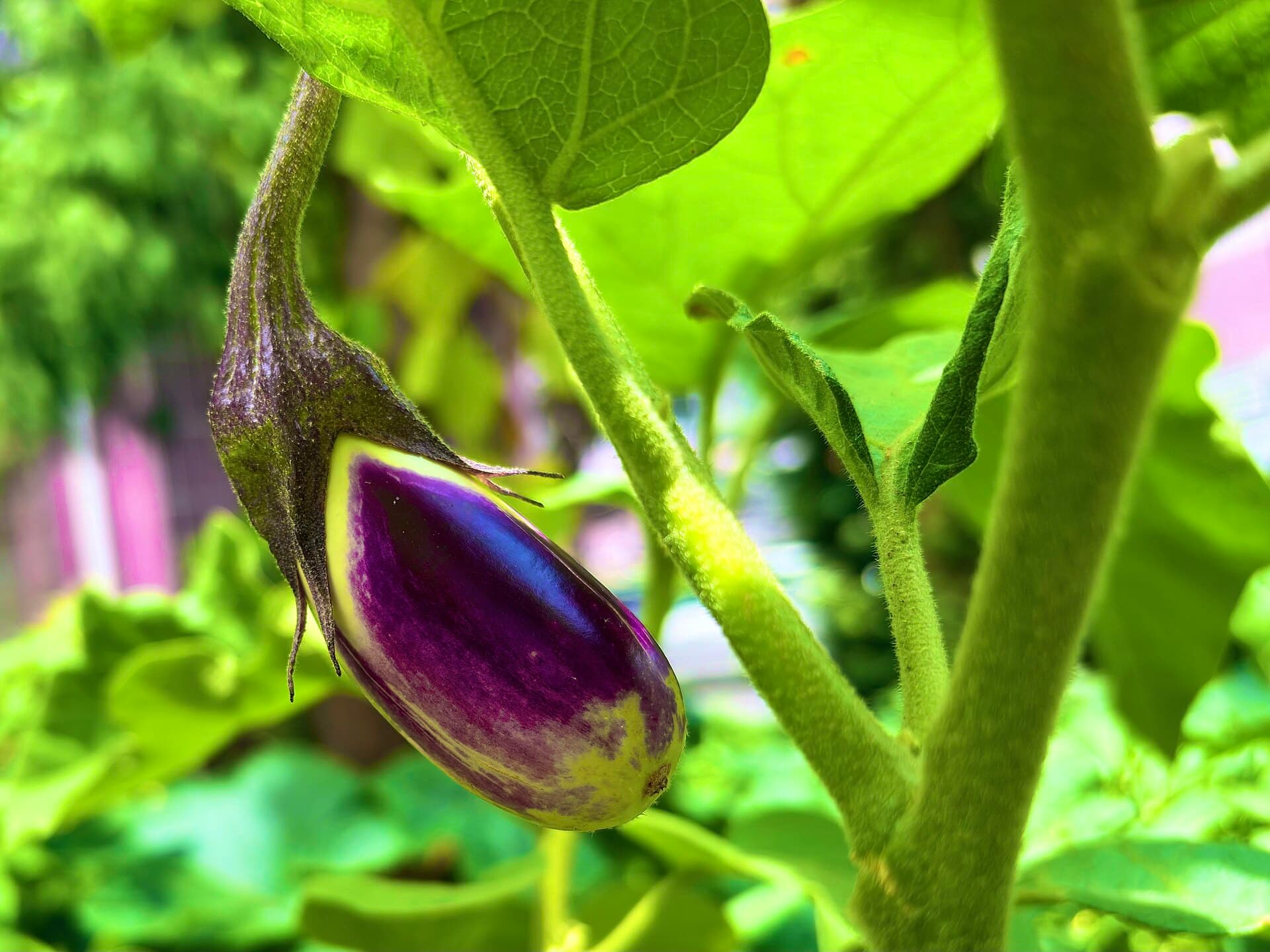
Eggplant (Solanum melongena) is a frost-tender, warm-season vegetable in the nightshade family, a relative of tomato, pepper and potato. Fruits range from oval and pear-shaped to long and slender, in purple-black, white, green or striped skins; Italian types are glossy and teardrop-shaped, and slender Chinese and Japanese types have thinner skin. A long warm season, even moisture and timely picking decide the harvest.
At a glance
- Light: Full sun.
- Water: Medium; keep moisture even.
- Spacing in the row: 18 to 24 in (46 to 61 cm), in conventional rows.
- Spacing between rows: 30 in (76 cm), in conventional rows.
- Good neighbors, by garden tradition: Beans, marigold and thyme.
- Keep apart, by garden tradition: Fennel and walnut.
When to plant
Ask your state extension service for the usual dates of your last frost in spring and first frost in fall, and plan around them and your crop's days to maturity. As a warm-season crop, eggplant belongs in the ground well after the last frost, as Illinois Extension's planting guide explains, and its chart puts transplants out from May 10 to June 15 in central Illinois.
Eggplant does not grow until temperatures warm, so start with transplants and plant out once frost danger has passed and nights reliably stay above 50 to 60°F (10 to 16°C), according to Illinois Extension and South Dakota State Extension.
Guides also go by soil temperature, planting out at 60°F (16°C) up to 65 to 70°F (18 to 21°C), as Utah State Extension and Georgia Extension describe.
Where and in what soil
Plant in a sunny, wind-sheltered spot that gets 8 to 10 hours of direct sun a day, though one guide accepts as few as 6; partial shade cuts yield and delays ripening. Give eggplant fertile, well-drained soil, keep the pH at 6.0 to 7.0, and feed it from a soil test, since it is a heavy feeder. Maryland Extension and Georgia Extension cover the light and the soil.
Nebraska Extension and South Dakota State Extension ask for a break from related crops: avoid ground that held tomatoes, peppers, potatoes or eggplant in the previous year, or, where a guide asks for longer, in the previous several years, because they share diseases. See our tomato guide.
Planting
Choose stocky, dark green transplants that are not yet in bloom, since plants with blossoms or fruit establish slowly and yield poorly, as Utah State Extension notes.
To raise your own plants, sow seed indoors four to six weeks up to eight to ten weeks before the set-out date. Harden plants off gradually, starting in shade, from about 4 days up to 2 weeks, as Georgia Extension and Nebraska Extension describe.
In conventional rows, set plants 18 to 24 inches (46 to 61 cm) apart, with 30 to 36 inches (76 to 91 cm) between rows. Guides run from 12 to 36 inches (30 to 91 cm) in the row and from 24 to 48 inches (61 to 122 cm) between rows. Raised beds take similar spacing, or 24 inches (61 cm) each way. Illinois Extension and Colorado State Extension give these spacings.
Nip back the growing tip once plants are 12 inches (30 cm) tall to encourage branching, and support them with a cage or trellis, as Maryland Extension advises.
Care
Soak the plants deeply once a week, with 1 inch (2.5 cm) of water at the least and up to 2 inches (5 cm); uneven watering can make fruit tough and leathery, and can cause root rot. Use drip irrigation if you can. Mulch with black plastic to warm the soil, but hold organic mulches such as straw until the soil reaches 75°F (24°C), because early organic mulch keeps the soil cool and slows growth and gives poor fruit set. Nebraska Extension and Utah State Extension cover the watering and the mulch.
Go easy on nitrogen, which encourages leaves and delays flowering. Side-dressing times differ: when plants are half grown and again after the first fruits are picked, after the first fruits form, right after flowering on soils low in nitrogen, or at 4 and 8 weeks after planting, as Illinois Extension and Maryland Extension describe.
Fruit sets best at 70 to 90°F (21 to 32°C), and pollen production falls when nights drop below 55°F (13°C), leaving poor fruit set, says Colorado State Extension.
Good neighbors, and plants to keep apart
Gardeners traditionally plant beans, marigold and thyme near eggplant and keep it away from fennel and walnut. Treat these as garden tradition, not as a promise of pest control or bigger yields. Sun, spacing, rotation and easy access to the plants come first.
Pests and problems
Shot holes in leaves. Flea beetles chew many small round holes and hit young plants hardest; they are the most common pest to watch for. Cover young plants with row cover, ventilating it above 80°F (27°C) and taking it off once flowers open so bees can pollinate, and plant later if you can to miss the first generation. If damage becomes severe, use an insecticide labeled for eggplant, follow the label, and observe the days between spraying and harvest, as South Dakota State Extension recommends.
Stippled or patchy leaves. Twospotted spider mites leave silvery or pale-yellow stipples and webbing under the leaves, according to NC State Extension. Eggplant lace bugs, most common in Maryland, Missouri, Oklahoma and the states south of them, cause roughly circular discolored patches with colonies underneath, and Colorado potato beetles eat buds and whole leaves.
Wilting plants. Verticillium wilt yellows and wilts leaves from the bottom up and browns the stem inside, as Utah State Extension describes. Home gardeners cannot treat it, so remove affected plants; rotating crops and solarizing the soil can help reduce it.
Scalded fruit. Direct sun in hot, dry weather scalds fruit. Keep moisture even and let plants grow big and leafy, or use shade cloth, as Colorado State Extension suggests.
Harvest and storage
Fruit is ready about 55 to 80 days after transplanting. Pick while the skin is glossy and the flesh firm, at 6 to 8 inches (15 to 20 cm) long. Illinois Extension says to press the fruit gently with a thumb: flesh that springs back is ready, hard flesh is too young, and a dent that stays means over mature, bitter fruit; Maryland Extension calls fruit ripe once the skin is very glossy and a thumbnail pressed slightly into the side leaves an indentation.
Cut with pruners or a knife, leave the cap on, and do not twist. Wear gloves, since stems and caps can have small prickly thorns, as Utah State Extension advises.
Eat eggplant soon. At room temperature it keeps up to 2 days in a paper bag kept in the coolest spot in the house, or no longer than 4 days; in the refrigerator it keeps 1 or 2 days up to about 5, though refrigeration can cause chilling injury. A week is possible at 45 to 50°F (7 to 10°C) in moist air, or at 50 to 55°F (10 to 13°C), as South Dakota State Extension and Georgia Extension say.
Common questions
Why did my eggplant stop growing after I planted it?
Probably the soil was cold: eggplant is more cold-sensitive than tomato or pepper, and even cold weather above freezing can injure it. Hold plants back, repotting if needed, until the soil warms; black plastic film and floating row covers help in a cool, early season, as Illinois Extension advises.
Why is my eggplant bitter or tough?
Tough skin follows unfavorable weather, meaning nights below 55°F (13°C) or days above 95°F (35°C), along with water stress and over-mature fruit, as Utah State Extension explains. Uneven moisture can make fruit bitter, and a dull or bronze skin marks an overripe, bitter fruit.
Can I grow eggplant in a container?
Yes. Give each plant a 2-gallon container, as Illinois Extension's container guide suggests. Choose a cultivar adapted to container growing, such as Dusky, and give it extra attention, because large containers dry out quickly.