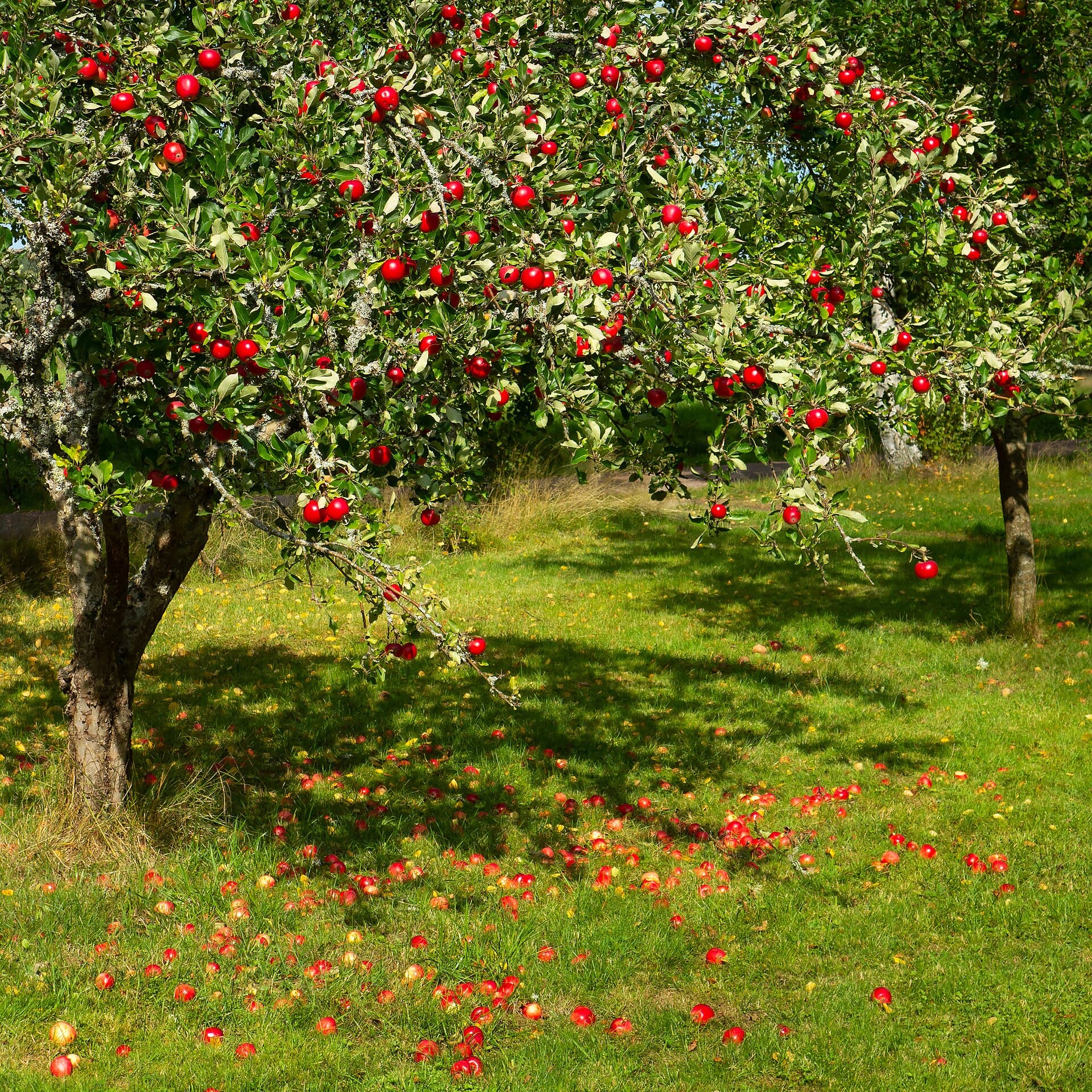
A dwarf apple tree can fruit in 2 to 3 years, while a standard tree can take 6 to 10, so the decision that matters most comes before you buy: how big a tree you have room for. The second is pollination, because most apple trees set fruit only with pollen from a different variety nearby. Settle both and the rest is pruning, watering and patience.
At a glance
- Sun: Full sun (all three sizes)
- Water: Medium (all three sizes)
- Years to bear: dwarf 2 to 3 years
- Spacing in the row: dwarf 6 to 10 ft (1.8 to 3.0 m); semi-dwarf 12 to 15 ft (3.7 to 4.6 m); standard 25 to 35 ft (7.6 to 10.7 m)
- Mature spread: dwarf 8 to 10 ft (2.4 to 3.0 m); semi-dwarf 15 ft (4.6 m); standard 25 ft (7.6 m)
- Mature height: dwarf 8 to 10 ft (2.4 to 3.0 m); semi-dwarf 12 to 15 ft (3.7 to 4.6 m); standard 20 to 30 ft (6.1 to 9.1 m)
- Good neighbors: for dwarf trees, chives, nasturtium and daffodil
- Keep apart from: walnut (all three sizes)
When to plant
Plant trees while they are dormant. Bare-root trees go in as soon as the soil can be worked in late winter or spring, before the buds open; potted trees can also go in during fall. Where the ground freezes early, plant in spring, because a fall-planted tree may not root before it freezes. Your state's cooperative extension service can tell you when the soil is usually workable where you live; a hardiness zone, which is a winter low, gives no planting dates.
Apples need winter cold, and most varieties need more of it than the mildest climates give. Extension guidance in Florida and Texas does name low-chill varieties, such as Anna and Dorsett Golden, that need only 300 to 400 hours of chill and fruit in zone 9.
Where and in what soil
Choose a site with full sun, at least 6 to 8 hours a day, and good air drainage. Avoid low pockets where cold air settles, since a late frost can kill the blossoms. The soil should be well drained and loamy, with a pH between 6.0 and 7.0. Keep apples well away from walnut trees.
Planting
Choose a size. Dwarf trees suit small yards, standard trees need an orchard's room, and semi-dwarf trees sit between. Dwarf trees come from grafting onto a dwarfing rootstock, such as Bud-9 or M27, which fruit in 2 to 3 years. Trees on these rootstocks have shallow roots and need a permanent stake. Bigger trees take longer to bear: extension sources give about 4 to 6 years for semi-dwarf trees and about 6 to 10 for standard trees, though one says standard trees bear in up to 8.
Pollination. Plant at least two varieties that flower at the same time, within about 50 feet (15 m) of each other. Dwarf apples need a pollinizer, and the same holds for the larger sizes, since they are the same species. A neighbor's apple tree or a flowering crabapple can be the partner.
In the ground. Soak bare roots in water for a few hours. Dig a hole as deep as the roots and 2 to 3 times as wide. Set the tree so the graft union, the swollen scar low on the trunk, stays 2 to 3 inches (5 to 8 cm) above the soil. Burying it lets the top root and cancels the dwarfing. Water well, then mulch 3 to 4 inches (8 to 10 cm) deep in a ring, keeping it clear of the trunk.
Care
Water. Give young trees about 1 inch (2.5 cm) a week in dry weather for the first two years, slowly and deeply. Established trees need extra water only in prolonged drought.
Feeding. Don't fertilize at planting. Feed lightly in early spring only if growth is weak. Too much nitrogen makes soft growth that invites fire blight.
Pruning. Prune in late winter, while the tree is dormant. Keep one strong central trunk with side branches spaced around it, and remove dead, diseased and crossing branches and shoots that grow straight up. Open the canopy so sun and air reach the fruit.
Thinning. About 4 to 6 weeks after bloom, thin fruit to one per cluster, 4 to 6 inches (10 to 15 cm) apart. It prevents broken branches and helps the tree fruit every year.
Good neighbors, and plants to keep apart
Gardeners plant chives, nasturtium and daffodil near dwarf apple trees, but the benefit is unproven. Walnut is the plant to keep away from all three sizes. Walnuts release juglone, which harms some plants, including tomatoes and potatoes. Planting apples well away from a walnut tree costs nothing.
Pests and problems
Codling moth. Small holes with brown waste in the fruit, and a caterpillar tunneling to the core. Pick up and bin dropped fruit. Bagging young fruit is sometimes advised, but one trial found that nylon bags did not significantly reduce codling moth, and another source says zip-closure plastic bags are effective while paper bags may deteriorate. Ask your state's extension service when the moth flies in your area before you use any labeled spray, and follow the label.
Apple scab. Olive-green to black, velvety spots on leaves and fruit, worst in cool, wet springs. Rake and bin fallen leaves in fall, prune for airflow and choose scab-resistant varieties. A labeled fungicide is a last step; follow the label.
Fire blight. Blossoms and shoot tips turn brown to black and wilt, and the tips curl into a shepherd's crook, as if scorched. Prune out infected wood in dry weather 8 to 12 inches (20 to 30 cm) below the damage, and disinfect your tools between cuts.
Gnawed bark. Voles, rabbits and deer strip bark at the base in winter and can girdle a young tree. Put a wire or plastic guard around the trunk in fall, and keep mulch back from it.
Harvest and storage
Judge ripeness by more than the calendar. The background color turns from green to yellow or cream, the seeds are brown, and the fruit comes away with an upward twist. Early varieties ripen from late summer, and later ones into October or November. Expect a light first crop and more each year.
Pick gently, keeping the stem on. Early varieties keep a few weeks, and late ones for months in a cold, humid place at 32 to 40°F (0 to 4°C). Check stored fruit often and remove any that bruise or rot.
Common questions
Do I need two apple trees?
Usually, yes. Most varieties need pollen from another variety that blooms at the same time. Two different trees, a neighbor's apple tree within reach or a flowering crabapple will do.
Which size should I choose?
Pick by space. Use the spacing and height figures above: dwarf trees at 8 to 10 feet tall fit a small yard, and standard trees at 20 to 30 feet need a large one. Semi-dwarf trees are a middle course.
Why is my tree not fruiting?
Age is the most common reason, so compare it with the years to bear above. Next come no pollination partner, a frost during bloom, and too much nitrogen. Heavy pruning, which pushes leafy shoots instead of fruit buds, can also be to blame.